
Lithium Battery vs Lead Acid Battery: Which Is Better for Solar, Home, and Backup Power?
Battery technology has changed dramatically over the last decade. Whether you are building a solar power system, upgrading your UPS backup, or choosing batteries for an RV, inverter, or energy storage system, lithium battery have become the most popular choice worldwide.
But many users in Pakistan, the USA, and the UK still ask an important question: should they choose lithium batteries or traditional lead acid batteries? This decision matters because it directly affects performance, cost, lifespan, and long-term savings.
In this guide, we will compare lithium battery vs lead acid battery in detail so you can make the right decision for your home, solar system, or business backup power needs.
Should you choose lithium batteries or lead acid batteries?
This is an important decision because batteries represent a large portion of your energy system’s cost. The right battery can save money, improve performance, and reduce maintenance over many years.
For users in Pakistan, the USA, and the UK, lithium batteries are becoming increasingly popular due to falling prices and better performance. However, lead acid batteries still dominate many applications because of their lower upfront cost.
In this guide, we will compare lithium battery vs lead acid battery in detail, including lifespan, efficiency, charging speed, maintenance, cost, safety, and real-world performance.
What Is a Lithium Battery?
A lithium battery stores energy using lithium ions that move between positive and negative electrodes during charging and discharging.
The most common type used in solar systems and backup power today is the Lithium Iron Phosphate (LiFePO4) battery.
These batteries are known for:
- Long lifespan
- Fast charging
- High efficiency
- Lightweight design
- Minimal maintenance
Lithium batteries are commonly used in:
- Solar energy storage
- Electric vehicles
- RVs
- Marine systems
- Home backup systems
- Portable power stations
What Is a Lead Acid Battery?
Lead acid batteries have been around for more than 150 years and remain one of the most widely used battery technologies.
They use lead plates and sulfuric acid to store electrical energy.
Common types include:
- Flooded Lead Acid (FLA)
- AGM Batteries
- Gel Batteries
Lead acid batteries are commonly used in:
- Cars
- UPS systems
- Backup power
- Small solar installations
- Industrial equipment
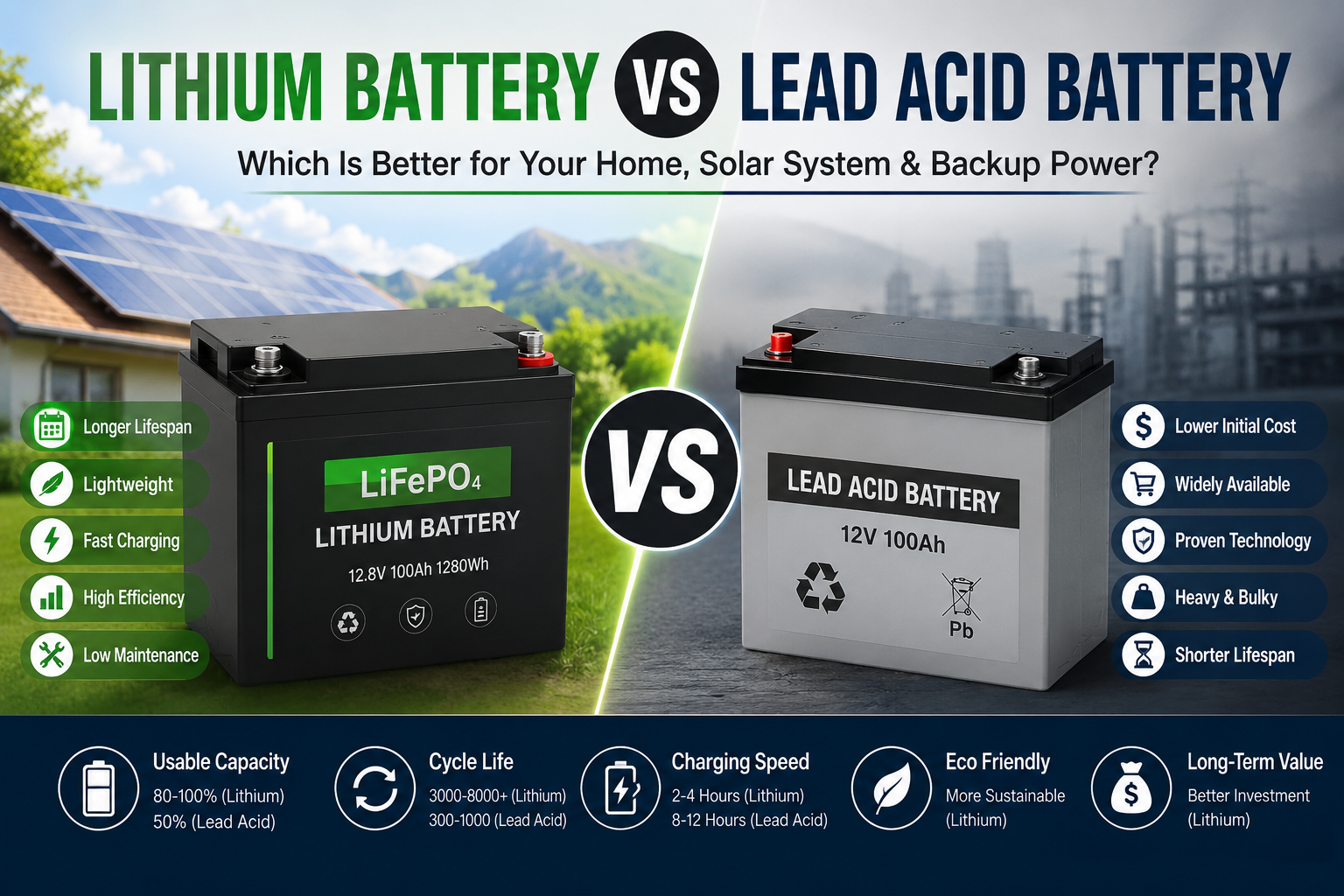
Lithium Battery vs Lead Acid Battery: Quick Comparison
| Feature | Lithium Batteries | Lead Acid Batteries |
|---|---|---|
| Lifespan | 10-15 years | 3-5 years |
| Cycle Life | 3,000-8,000 cycles | 300-1,000 cycles |
| Charging Speed | Very Fast | Slow |
| Efficiency | 95-99% | 70-85% |
| Weight | Lightweight | Heavy |
| Maintenance | Almost None | Regular Maintenance |
| Depth of Discharge | 80-100% | 50% Recommended |
| Cost | Higher Initial Cost | Lower Initial Cost |
| Space Required | Smaller | Larger |
| Long-Term Value | Excellent | Moderate |
Differences Between Lithium and Lead Acid Batteries
Energy Density
Energy density refers to how much energy a battery can store in a given size.
Lithium batteries offer much higher energy density.
This means:
- More power in less space
- Lighter systems
- Easier installation
A lithium battery bank can often provide the same energy storage as a much larger lead acid setup.
Usable Capacity
One major difference is usable capacity.
Lead Acid
Experts recommend using only about 50% of capacity.
Example:
A 100Ah lead acid battery effectively provides about 50Ah usable power.
Lithium
Lithium batteries can safely discharge 80-100%.
Example:
A 100Ah lithium battery often delivers 80-100Ah usable power.
This means fewer batteries are needed.
Lifespan Comparison
Battery lifespan is often measured in cycles.
One cycle equals one full charge and discharge.
| Battery Type | Average Cycles |
|---|---|
| Flooded Lead Acid | 300-500 |
| AGM | 500-1,000 |
| Gel | 500-1,200 |
| LiFePO4 | 3,000-8,000 |
Practical Example
If you use one cycle daily:
Lead Acid:
- May last 2-4 years
Lithium:
- May last 10-15 years
This is why many solar experts now recommend lithium batteries despite their higher purchase price.
Charging Speed Comparison
Lithium batteries charge significantly faster.
Lead Acid Charging
Charging slows considerably near full capacity.
A full recharge may take:
- 8-12 hours
Lithium Charging
Lithium batteries accept higher charging currents.
Typical charging time:
- 2-4 hours
This is extremely useful for:
- Solar systems
- Backup power
- RVs
- Mobile applications
Efficiency Comparison
Efficiency measures how much energy can be recovered after charging.
| Battery Type | Efficiency |
|---|---|
| Lead Acid | 70-85% |
| Lithium | 95-99% |
Example
If you store 1000 watts:
Lead Acid
- May return only 700-850 watts
Lithium
- May return 950-990 watts
Over years of use, this difference can save substantial energy costs.
Weight and Size Comparison
Weight matters in many installations.
| Battery Type | Approximate Weight |
|---|---|
| 100Ah Lead Acid | 25-35 kg |
| 100Ah Lithium | 10-15 kg |
Lithium batteries are often less than half the weight of lead acid batteries.
This makes transportation and installation easier.
Maintenance Requirements
Lead Acid Batteries
Lead acid batteries often require:
- Water level checks
- Terminal cleaning
- Ventilation
- Corrosion prevention
Neglecting maintenance can reduce lifespan.
Lithium Batteries
Lithium batteries require:
- Virtually no maintenance
- No water topping
- No acid checks
- No corrosion management
This saves both time and effort.
Cost Analysis
Initial cost is where lead acid batteries have an advantage.
Example Purchase Price
| Battery Type | Average Cost |
|---|---|
| Lead Acid 100Ah | Lower |
| Lithium 100Ah | Higher |
However, looking only at purchase price can be misleading.
Total Cost of Ownership
Consider:
- Lifespan
- Efficiency
- Replacement costs
- Maintenance expenses
A lithium battery may cost more upfront but often becomes cheaper over 10 years because it lasts much longer.
Expert Insight
Many homeowners replace lead acid batteries multiple times during the lifespan of one lithium battery.
Solar System Performance
Solar energy storage is one area where lithium batteries shine.
Why Lithium Works Better for Solar
- Faster charging from solar panels
- Greater usable capacity
- Better efficiency
- Longer lifespan
- Improved performance during daily cycling
Example Solar Scenario
Suppose you have:
- 5kW solar system
- Daily battery cycling
Lead acid batteries may require replacement within a few years.
Lithium batteries can continue performing efficiently for a decade or more.
For off-grid systems, lithium batteries are usually the preferred choice today.
Safety Considerations
Both battery types can be safe when installed correctly.
Lead Acid Risks
- Acid leakage
- Hydrogen gas release
- Corrosion
- Heavy weight handling risks
Lithium Risks
Older lithium technologies had thermal concerns.
However, modern LiFePO4 batteries offer excellent safety and thermal stability.
Many premium systems include:
- Battery Management Systems (BMS)
- Temperature monitoring
- Overcharge protection
- Short-circuit protection
Environmental Impact
Lead Acid Batteries
Advantages:
- Highly recyclable
Disadvantages:
- Lead contamination risk
- Acid disposal concerns
Lithium Batteries
Advantages:
- Longer lifespan
- Less frequent replacement
Disadvantages:
- More complex recycling process
Because lithium batteries last much longer, fewer replacements are needed over time.
Lithium Battery Pros and Cons
Pros
✓ Long lifespan
✓ Fast charging
✓ Lightweight
✓ High efficiency
✓ Deep discharge capability
✓ Maintenance-free
✓ Excellent solar performance
✓ Lower long-term cost
Cons
✗ Higher purchase price
✗ Requires compatible charger
✗ Cold-weather charging limitations in some models
Lead Acid Battery Pros and Cons
Pros
✓ Lower initial cost
✓ Widely available
✓ Proven technology
✓ Easy recycling infrastructure
Cons
✗ Short lifespan
✗ Heavy weight
✗ Lower efficiency
✗ Slower charging
✗ Higher maintenance
✗ Lower usable capacity
Best Applications for Lithium Batteries
Lithium batteries are ideal for:
- Home solar systems
- Off-grid power
- RVs
- Boats
- Portable power stations
- Telecom systems
- Backup energy storage
- High-performance applications
Best Applications for Lead Acid Batteries
Lead acid batteries are suitable for:
- Budget-conscious users
- Small UPS systems
- Automotive starting batteries
- Low-cycle backup applications
- Temporary installations
Expert Tips Before Buying a Battery
1. Calculate Daily Energy Usage
Know how many watt-hours you consume each day.
2. Consider Long-Term Cost
Do not focus only on purchase price.
Look at:
- Lifespan
- Efficiency
- Replacement frequency
3. Check Warranty
Quality lithium batteries often include warranties of:
- 5 to 10 years
4. Verify Battery Management System (BMS)
A good BMS protects your investment.
5. Match Battery to Usage
Heavy daily cycling favors lithium batteries.
Occasional backup use may justify lead acid batteries.
Featured Snippet: Which Is Better, Lithium or Lead Acid Battery?
Lithium batteries are generally better than lead acid batteries because they last longer, charge faster, provide higher efficiency, require no maintenance, and offer more usable capacity. While lithium batteries cost more initially, they usually deliver better long-term value, especially for solar energy storage and backup power systems.
Frequently Asked Questions (FAQs)
1. Are lithium batteries better than lead acid batteries?
Yes. Lithium batteries typically offer longer lifespan, better efficiency, faster charging, and lower maintenance.
2. How long do lithium batteries last?
Most quality lithium batteries last between 10 and 15 years, depending on usage.
3. Why are lithium batteries more expensive?
They use advanced technology and provide significantly longer service life.
4. Can I replace a lead acid battery with a lithium battery?
In many cases, yes. However, your inverter and charger must support lithium batteries.
5. Which battery is best for solar systems?
Lithium batteries are generally considered the best option for modern solar energy storage.
6. Are lithium batteries safe?
Yes. Modern LiFePO4 batteries are among the safest battery technologies available.
7. Do lithium batteries need maintenance?
No. Most lithium batteries are virtually maintenance-free.
8. What is the biggest advantage of lithium batteries?
Their long lifespan and high usable capacity.
9. Are lead acid batteries still worth buying?
Yes, especially when initial budget is the main concern.
10. Which battery saves more money over time?
Lithium batteries usually save more money because they last longer and waste less energy.
Conclusion
Choosing between lithium batteries and lead acid batteries depends on your budget, energy needs, and long-term goals.
If you need the lowest upfront cost, lead acid batteries remain a practical option. They work well for occasional backup power and low-demand applications.
However, if you want maximum performance, longer lifespan, higher efficiency, faster charging, and lower maintenance, lithium batteries are the clear winner.
For most modern solar systems in Pakistan, the USA, and the UK, lithium batteries provide the best long-term value. Although the initial investment is higher, the longer service life and improved efficiency often make them the smarter financial choice.
Actionable Advice: If your battery will be used daily—especially in a solar energy system—invest in a high-quality LiFePO4 lithium battery. The higher upfront cost is usually recovered through longer life, better performance, and fewer replacements.