
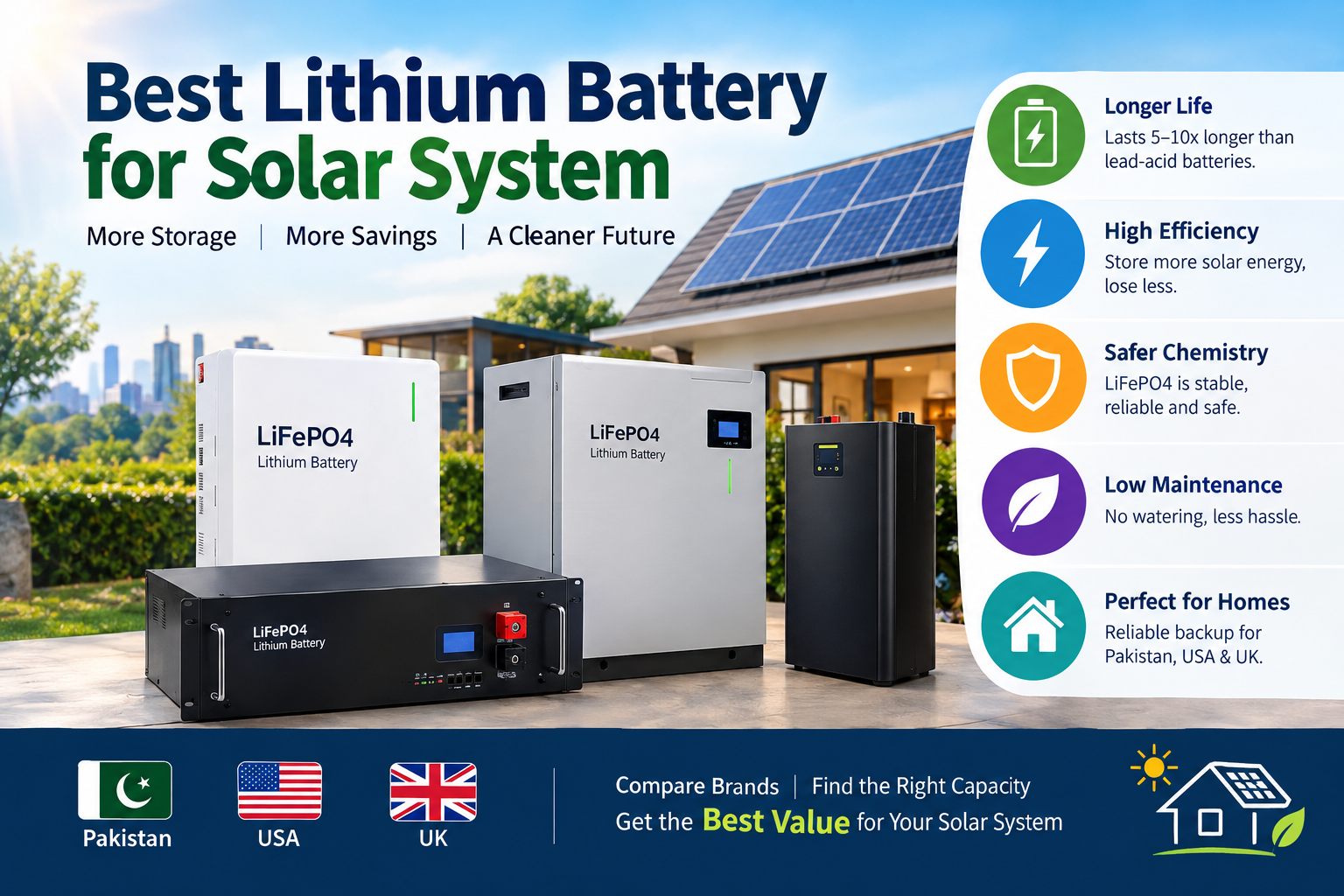
Best Lithium Battery for Solar System: Complete Buying Guide
Choosing the best lithium battery for a solar system is one of the most important decisions you can make when building a reliable solar power setup.
Solar panels produce electricity during the day, but your home may still need power at night, during load shedding, or when the grid goes down. A good battery stores excess solar energy and makes it available when you need it.
Today, lithium iron phosphate (LiFePO4) batteries have become one of the most popular choices for residential and commercial solar systems. They offer long cycle life, high usable capacity, fast charging, and generally better efficiency than traditional lead-acid batteries.
However, not every lithium battery is the same.
Battery chemistry, capacity, voltage, battery management system (BMS), cycle life, warranty, inverter compatibility, temperature performance, and after-sales support can all affect the real-world value of a battery.
This guide explains how to choose the best lithium battery for a solar system in Pakistan, the USA, and the UK.
What Is a Lithium Solar Battery?
A lithium solar battery is a rechargeable battery designed to store electricity generated by solar panels or another power source.
During the day, your solar panels can produce more electricity than your home consumes. Instead of wasting that excess energy, the solar inverter can send it to the battery.
Later, the stored energy can power lights, fans, refrigerators, appliances, and other loads.
Most modern solar storage systems use lithium iron phosphate (LiFePO4) chemistry because of its combination of safety, durability, efficiency, and long service life.
A typical lithium solar battery system includes:
- Lithium battery cells
- Battery Management System (BMS)
- Battery enclosure
- Protection equipment
- Communication interface
- Positive and negative terminals
- Inverter connection
- Monitoring system
The BMS is particularly important because it monitors battery voltage, current, temperature, state of charge, and other operating conditions.
Why Lithium Batteries Are Better for Solar
Lithium batteries have several advantages over traditional lead-acid batteries.
1. Longer Cycle Life
A quality LiFePO4 battery can provide thousands of charge and discharge cycles when operated within the manufacturer’s recommended limits.
That can make lithium batteries a better long-term investment than conventional lead-acid batteries.
2. Higher Usable Capacity
Battery capacity is usually measured in kilowatt-hours (kWh).
However, the entire rated capacity is not always practically available.
For example, repeatedly deeply discharging a traditional lead-acid battery can significantly reduce its lifespan.
Lithium batteries generally allow a much greater portion of their rated capacity to be used.
3. Better Efficiency
Lithium batteries generally have high round-trip efficiency, meaning less energy is lost during charging and discharging.
This matters in solar systems because every unit of electricity has value.
4. Faster Charging
Lithium batteries can typically accept relatively high charging currents when the battery, BMS, inverter, wiring, and installation are properly designed.
This is especially useful when solar production is limited to a few hours.
5. Lower Maintenance
Unlike flooded lead-acid batteries, LiFePO4 batteries normally do not require regular water topping-up.
They are also much less prone to issues associated with electrolyte maintenance.
6. Lighter and More Compact
For the same nominal energy storage, lithium batteries can be significantly lighter and more compact than many lead-acid alternatives.
This can make installation easier.
Best Lithium Battery Chemistry for Solar
When people search for the best lithium battery for solar systems, they are usually looking for the best lithium chemistry as well as the best brand.
For most home solar applications, LiFePO4 is one of the strongest choices.
LiFePO4 Battery
LiFePO4 stands for lithium iron phosphate.
It is widely used for stationary energy storage because it offers:
- Long cycle life
- Good thermal stability
- Strong safety characteristics
- High usable capacity
- Low maintenance
- Good efficiency
- Suitable performance for daily cycling
For a home solar battery that charges and discharges every day, these characteristics are extremely valuable.
NMC Lithium Batteries
Nickel manganese cobalt (NMC) batteries are another lithium chemistry.
They can offer high energy density and are common in electric vehicles and portable applications.
However, for stationary residential solar storage, LiFePO4 has become an increasingly attractive option because energy density is usually less important than safety, durability, and cost per stored kWh.
Which Is Better?
For most residential solar installations:
LiFePO4 is the preferred choice.
NMC can still be appropriate for certain applications, but the battery should be selected based on the complete system rather than chemistry alone.
LiFePO4 vs Lead-Acid Batteries
Here is a simplified comparison.
| Feature | LiFePO4 | Lead-Acid |
|---|---|---|
| Cycle life | High | Lower |
| Usable capacity | High | Lower |
| Charging speed | Fast | Slower |
| Efficiency | High | Lower |
| Maintenance | Very low | Can be higher |
| Weight | Lower | Higher |
| Depth of discharge | Generally high | Generally lower for long life |
| Upfront cost | Higher | Lower |
| Long-term value | Often better | Can be lower |
| Daily solar cycling | Excellent | Less ideal |
The cheaper purchase price of a lead-acid battery can look attractive.
However, solar batteries should be evaluated based on total cost of ownership, not only purchase price.
What Makes the Best Lithium Battery?
The best lithium battery is not necessarily the battery with the largest capacity or the lowest price.
Look at these factors instead.
1. Battery Chemistry
For most home solar applications, look for LiFePO4.
2. Battery Capacity
Capacity determines how much energy the battery can store.
A battery rated at 10 kWh stores approximately twice the nominal energy of a 5 kWh battery.
3. Usable Capacity
Check the manufacturer’s specified usable energy or recommended depth of discharge.
A battery advertised as 10 kWh may not provide 10 kWh of practical usable energy under every operating condition.
4. Cycle Life
A high-quality battery should provide a clearly specified cycle-life rating.
But don’t compare cycle numbers without checking the test conditions.
For example, cycle life can depend on:
- Depth of discharge
- Temperature
- Charge/discharge rate
- End-of-life capacity threshold
5. Battery Management System
A good BMS is essential.
It should provide protection against conditions such as:
- Overcharging
- Over-discharging
- Excessive current
- Excessive temperature
- Cell imbalance
- Short circuit conditions
6. Warranty
Check:
- Warranty period
- Cycle limit
- Throughput limit
- Guaranteed remaining capacity
- Warranty conditions
- Installer requirements
A long warranty is useful, but the warranty terms matter more than the headline number.
7. Inverter Compatibility
This is one of the most commonly overlooked factors.
The battery must work correctly with your inverter.
Communication may use protocols such as CAN or RS485, depending on the equipment.
Without proper communication, some inverter-battery combinations may not provide the expected charging, protection, or state-of-charge functionality.
Best Lithium Battery Voltage
Lithium solar batteries commonly come in different voltage classes.
For residential systems, you will commonly encounter:
- 12V
- 24V
- 48V
- High-voltage battery systems
12V Lithium Battery
A 12V LiFePO4 battery can be useful for:
- Small backup systems
- RVs
- Boats
- Small off-grid installations
- Low-power applications
For a complete home solar system, however, 48V systems are often more practical at higher power levels.
24V Lithium Battery
24V systems sit between 12V and 48V.
They can work well for medium-sized applications.
48V Lithium Battery
For residential solar systems, 48V-class batteries are extremely common.
At the same power level, increasing system voltage reduces the current requirement.
For example, a 5,000W load requires approximately:
5,000 ÷ 48 = 104A
Ignoring inverter losses and voltage variation.
At 24V:
5,000 ÷ 24 = 208A
Lower current can make cable sizing and system design easier, although all components still need to be correctly rated.
How Much Battery Capacity Do You Need?
The correct battery size depends on your electricity consumption and the backup time you need.
A simple calculation is:
Battery Energy Required = Load × Backup Time
Suppose your essential load is 1,000 watts.
You want 5 hours of backup.
Required energy:
1,000W × 5 hours = 5,000Wh
That’s approximately:
5 kWh
But you should also account for inverter losses and other system losses.
Therefore, selecting a battery slightly larger than the theoretical minimum is usually sensible.
Practical Battery Sizing Examples
Example 1: Small Home Backup
Suppose your essential loads are:
- 4 LED lights: 40W
- 2 fans: 120W
- Wi-Fi router: 15W
- TV: 100W
- Refrigerator average consumption: 100W
Approximate running load:
375W
For 6 hours:
375 × 6 = 2.25 kWh
A battery around 3 kWh could provide useful backup depending on actual refrigerator cycling, inverter efficiency, battery limits, and other loads.
Example 2: Medium Home
Suppose your essential load averages 1,500W.
For 5 hours:
1,500 × 5 = 7.5 kWh
A battery around 8–10 kWh could be appropriate depending on your required reserve and operating conditions.
Example 3: Larger Home
If your average backup load is 3,000W and you want 5 hours:
3,000 × 5 = 15 kWh
You may therefore need a battery system around 15–20 kWh depending on the desired reserve and system losses.
Lithium Battery Comparison
| Battery Size | Suitable Application | Approximate Use |
|---|---|---|
| 2–3 kWh | Small backup | Lights, fans, router, TV |
| 5 kWh | Small/medium home | Essential appliances |
| 10 kWh | Medium home | Extended backup |
| 15 kWh | Large home | Multiple appliances |
| 20+ kWh | Large home/business | High energy demand |
These are general examples rather than fixed sizing recommendations.
Your actual battery should be selected from your measured electricity consumption.
Best Lithium Battery Brands
There is no single battery brand that is automatically the best for every country or every solar inverter.
Well-known energy-storage manufacturers and product families include companies such as:
- BYD
- Pylontech
- Dyness
- EG4
- Enphase
- Tesla
- Sonnen
- Victron Energy
- Discover Energy Systems
- Simpliphi/Briggs & Stratton
Availability varies significantly between Pakistan, the USA, and the UK.
The most important consideration is not simply the logo on the battery.
You should evaluate:
- Battery chemistry
- Capacity
- Usable capacity
- BMS quality
- Inverter compatibility
- Warranty
- Cycle life
- Local technical support
- Replacement availability
- Installation quality
Best Lithium Batteries for Pakistan
Pakistan has a particularly strong use case for solar batteries because of grid outages, high summer electricity demand, and increasing residential solar adoption.
For Pakistani homes, the ideal battery should tolerate the local installation environment.
Important Considerations in Pakistan
Temperature
Pakistan can experience very high summer temperatures.
Battery installation should therefore avoid direct sunlight and excessive heat.
A cool, dry, ventilated and manufacturer-approved installation location is preferable.
Inverter Compatibility
Popular hybrid inverter brands in Pakistan can have different battery communication requirements.
Before purchasing, confirm that the exact battery model is compatible with your inverter model.
Local Support
This is extremely important.
A battery may look cheap online, but if replacement parts, BMS support, warranty service, or technical assistance are unavailable locally, the apparent saving may disappear.
For Load-Shedding Backup
If your primary objective is backup during load shedding, calculate the energy consumption of your essential loads rather than sizing the battery based only on the inverter rating.
An 8kW inverter does not mean you automatically need an 8kWh battery.
Best Lithium Batteries for USA Homes
In the USA, battery selection is often influenced by:
- Solar self-consumption
- Time-of-use electricity rates
- Backup power
- Utility requirements
- Whole-home backup
- Solar-plus-storage incentives
- Local installation regulations
Popular residential storage ecosystems include Tesla Powerwall, Enphase, and other AC- and DC-coupled systems.
For a USA installation, homeowners should also consider whether the complete battery system has the certifications and approvals required for their location.
The installer should verify compatibility with the solar inverter, electrical service, backup loads, and applicable local requirements.
Best Lithium Batteries for UK Homes
UK homeowners often use batteries to:
- Store excess solar generation
- Reduce grid electricity purchases
- Shift energy consumption
- Take advantage of time-of-use tariffs
- Increase solar self-consumption
Battery sizing should consider the household’s daily electricity consumption rather than simply the size of the solar panel array.
For example, a home with a 5kW solar system does not necessarily need a 10kWh battery.
Your consumption pattern is more important.
Battery and Inverter Compatibility
A battery and inverter should be treated as one system.
Before purchasing a lithium battery, check:
Voltage
The battery voltage range must match the inverter’s battery input requirements.
Maximum Charge Current
The inverter should not exceed the battery’s permitted charging current.
Maximum Discharge Current
The battery must be capable of delivering the required current.
Communication
Check whether the inverter and battery support the same communication method and approved battery protocol.
Firmware
Some manufacturers require specific firmware versions for compatibility.
Battery Expansion
If you plan to add batteries later, verify that the manufacturer allows parallel expansion.
This can save significant money in the future.
How to Calculate Battery Size for Solar
Use this simple process.
Step 1: Calculate Your Average Load
Record your home’s actual electricity consumption.
Smart meters, inverter monitoring, energy monitors, and electricity bills can help.
Step 2: Identify Essential Loads
For backup systems, separate essential loads from high-power appliances.
For example:
Essential:
- Lights
- Fans
- Refrigerator
- Wi-Fi
- Television
- Small electronics
Non-essential:
- Electric heater
- Electric oven
- Large water heater
- High-power pumps
- Multiple air conditioners
Step 3: Determine Backup Time
Decide how many hours of backup you need.
Step 4: Calculate Energy
Use:
Energy = Power × Time
Step 5: Add a Practical Margin
Account for:
- Inverter losses
- Battery operating limits
- Temperature
- Aging
- Unexpected loads
Step 6: Check Battery Power Rating
Energy capacity is not enough.
A battery might store 10kWh but have a limited continuous output.
Always check both:
kWh = how much energy it stores
and
kW = how much power it can deliver
kWh vs kW: What’s the Difference?
This is a common source of confusion.
kWh measures energy.
kW measures power.
Think of a battery as a water tank.
- kWh = amount of water stored
- kW = how quickly water can flow out
A 10kWh battery does not automatically mean it can deliver 10kW.
Always check the battery’s continuous and peak discharge ratings.
Pros and Cons of Lithium Solar Batteries
Pros
- Long service life
- High efficiency
- High usable capacity
- Fast charging
- Low maintenance
- Compact design
- Lower weight than many lead-acid systems
- Excellent for daily solar cycling
- Good performance when properly installed
Cons
- Higher upfront cost
- Requires a suitable BMS
- Inverter compatibility matters
- Extreme temperatures can affect performance
- Quality varies greatly between manufacturers
- Installation must follow manufacturer requirements
Expert Tips for Buying a Lithium Solar Battery
Tip 1: Don’t Buy Based on Ah Alone
A battery advertised as “100Ah” doesn’t tell you its complete energy capacity without knowing the voltage.
For example:
48V × 100Ah = approximately 4.8kWh nominal energy
while:
12V × 100Ah = approximately 1.2kWh
So always compare batteries using kWh, not only Ah.
Tip 2: Check the Battery’s Continuous Power
A battery may have excellent capacity but insufficient output for your loads.
Check the continuous discharge rating before purchasing.
Tip 3: Ask About the BMS
Don’t simply ask whether the battery has a BMS.
Ask what the BMS actually protects against and what continuous current it supports.
Tip 4: Check Cell Quality
For larger systems, cell quality is important.
Ask the supplier about:
- Cell manufacturer
- Cell grade
- Cell configuration
- BMS manufacturer
- Factory testing
Be cautious if a seller refuses to provide basic technical specifications.
Tip 5: Don’t Ignore Temperature
Heat is one of the biggest concerns for battery installations.
Never install a battery where it is exposed to direct sunlight or excessive heat.
Follow the manufacturer’s specified operating temperature range.
Tip 6: Buy From an Authorized Supplier
A genuine battery with local warranty support can be much more valuable than a cheaper imported battery with uncertain authenticity.
Tip 7: Compare Cost Per Usable kWh
Instead of asking:
“Which battery is cheapest?”
ask:
“What am I paying for each usable kWh over the battery’s expected life?”
This produces a much more meaningful comparison.
What Is the Best Lithium Battery for Solar System?
For most residential solar systems, a high-quality LiFePO4 battery with a reliable BMS, adequate usable capacity, strong warranty, and confirmed inverter compatibility is an excellent choice.
The ideal battery size depends on your electricity consumption and backup requirements.
For many homes, a 48V LiFePO4 battery system is a practical starting point because it can support relatively high power with lower current than lower-voltage systems.
However, the “best” battery differs from one installation to another.
Featured Snippet: Quick Answer
The best lithium battery for a solar system is usually a LiFePO4 (lithium iron phosphate) battery with a high-quality BMS, long cycle life, high usable capacity, good efficiency, and confirmed compatibility with your solar inverter. For residential systems, 48V-class LiFePO4 batteries are commonly used for medium and larger installations.
Frequently Asked Questions
1. What is the best lithium battery for a solar system?
For most residential applications, LiFePO4 is one of the best lithium chemistries because it combines long cycle life, good safety characteristics, high usable capacity, and low maintenance.
The best specific battery depends on your inverter, energy consumption, budget, and local support.
2. Is LiFePO4 better than lead-acid for solar?
In many daily-cycling solar applications, yes.
LiFePO4 generally offers higher usable capacity, better efficiency, longer cycle life, faster charging, and lower maintenance.
Lead-acid batteries can still make sense when upfront cost is the primary concern.
3. How many lithium batteries do I need for a 5kW solar system?
The solar panel capacity alone does not determine the required battery size.
A 5kW solar system could use anything from a small battery to a much larger battery depending on household consumption, backup requirements, solar production, and grid usage.
4. Is a 100Ah lithium battery enough for a house?
It depends on the battery voltage.
A 100Ah 12V battery has approximately 1.2kWh of nominal energy.
A 100Ah 48V battery has approximately 4.8kWh.
Therefore, “100Ah” alone isn’t enough information to determine whether a battery is suitable.
5. How long does a lithium solar battery last?
A quality lithium solar battery can potentially provide many years of service when properly installed and operated within its specified limits.
Actual lifespan depends on cycling frequency, depth of discharge, temperature, charging conditions, battery quality, and aging.
Always check the manufacturer’s warranty and cycle-life conditions.
6. Can lithium batteries be used with any solar inverter?
No.
Battery voltage, charge/discharge current, communication protocols, firmware, and manufacturer compatibility can all matter.
Always verify compatibility before purchase.
7. What size lithium battery is best for a 10kW solar system?
There is no universal answer.
A 10kW solar array could be paired with a battery of 5kWh, 10kWh, 20kWh, or more depending on energy consumption and the purpose of storage.
If your objective is evening energy shifting, calculate how much electricity you normally use after solar production falls.
8. Are lithium batteries safe for home solar systems?
Quality lithium batteries designed for stationary energy storage can be suitable for residential applications when installed correctly.
The battery chemistry, BMS, certifications, enclosure, installation location, protection equipment, and operating conditions all matter.
9. Is a 48V lithium battery better than a 12V battery?
For many medium and larger solar systems, 48V systems are more practical because they require lower current for the same power.
12V batteries remain useful for smaller systems and specialized applications.
10. What should I check before buying a lithium solar battery?
Check these specifications:
- Chemistry
- Nominal voltage
- Usable capacity
- Continuous discharge power
- Maximum charge current
- Cycle life
- BMS
- Operating temperature
- Inverter compatibility
- Warranty
- Certifications
- Local service
- Battery expansion capability
Conclusion
Choosing the best lithium battery for a solar system is about much more than choosing the battery with the highest Ah rating or the lowest price.
For most residential solar installations, LiFePO4 technology is an excellent starting point because it offers a strong combination of safety, usable capacity, efficiency, durability, and low maintenance.
Before buying, focus on the complete system.
Check the battery’s usable kWh, voltage, continuous power, BMS, cycle life, operating temperature, warranty, inverter compatibility, certifications, and local support.
For many medium and large residential systems, a 48V-class lithium battery can be a practical choice. However, the correct capacity should always be calculated from your actual electricity consumption and required backup time.
The most important advice:
Don’t buy a lithium battery simply because it has a high Ah rating.
Instead, compare usable kWh, power output, expected service life, warranty, compatibility, and total cost of ownership.
If you’re installing a solar system in Pakistan, the USA, or the UK, also make sure the battery and installation meet the applicable local electrical and safety requirements.
A properly sized, high-quality lithium battery can turn a solar installation from a daytime electricity generator into a much more useful energy storage and backup system.