
How Lithium Batteries Work: The Ultimate Guide to Modern Energy
Imagine a world where you have to plug in your phone every 30 minutes, or where electric vehicles are just a sci-fi dream. Sounds frustrating, right? Thankfully, we don’t live in that world, and we have one primary hero to thank: lithium batteries.
From the smartphone in your pocket to the Tesla driving down a US highway, the roaring electric rickshaws in Pakistan, and the massive grid storage setups in the UK, lithium-ion technology powers our modern lives.
But what exactly happens inside these sleek metal casings? How do tiny atoms keep your laptops running for hours, and why do these batteries eventually wear out?
This comprehensive guide breaks down the complex science into simple terms. We will explore the internal anatomy, the chemistry of charging, real-world applications, and practical tips to double your battery life.
Table of Contents
- The Basics: What is a Lithium Battery?
- The Core Anatomy: The Four Critical Components
- The Science: How Lithium Batteries Work (Step-by-Step)
- Main Types of Lithium Batteries and Their Uses
- Pros and Cons of Lithium Batteries
- Why Do Lithium Batteries Degrade Over Time?
- Safety First: Preventing Thermal Runaway
- Expert Tips to Maximize Your Battery Lifespan
- Frequently Asked Questions (FAQs)
- Conclusion and Actionable Advice
The Basics: What is a Lithium Battery?
A lithium battery is a type of rechargeable battery that relies on the movement of lithium ions to store and release electrical energy. Unlike old-school disposable AA batteries, lithium-ion batteries are built for thousands of use cycles.
Engineers choose lithium because it is the lightest of all metals. It also holds an incredible amount of electrochemical potential. This means it can store a massive amount of energy in a tiny, lightweight package—a trait known as high energy density.
Today, these powerhouses drive three major global industries:
- Portable Electronics: Smartphones, laptops, tablets, and vapes.
- Transportation: Electric vehicles (EVs), e-bikes, and hybrid cars.
- Renewable Energy: Solar power storage systems in homes and commercial grids.
The Core Anatomy: The Four Critical Components
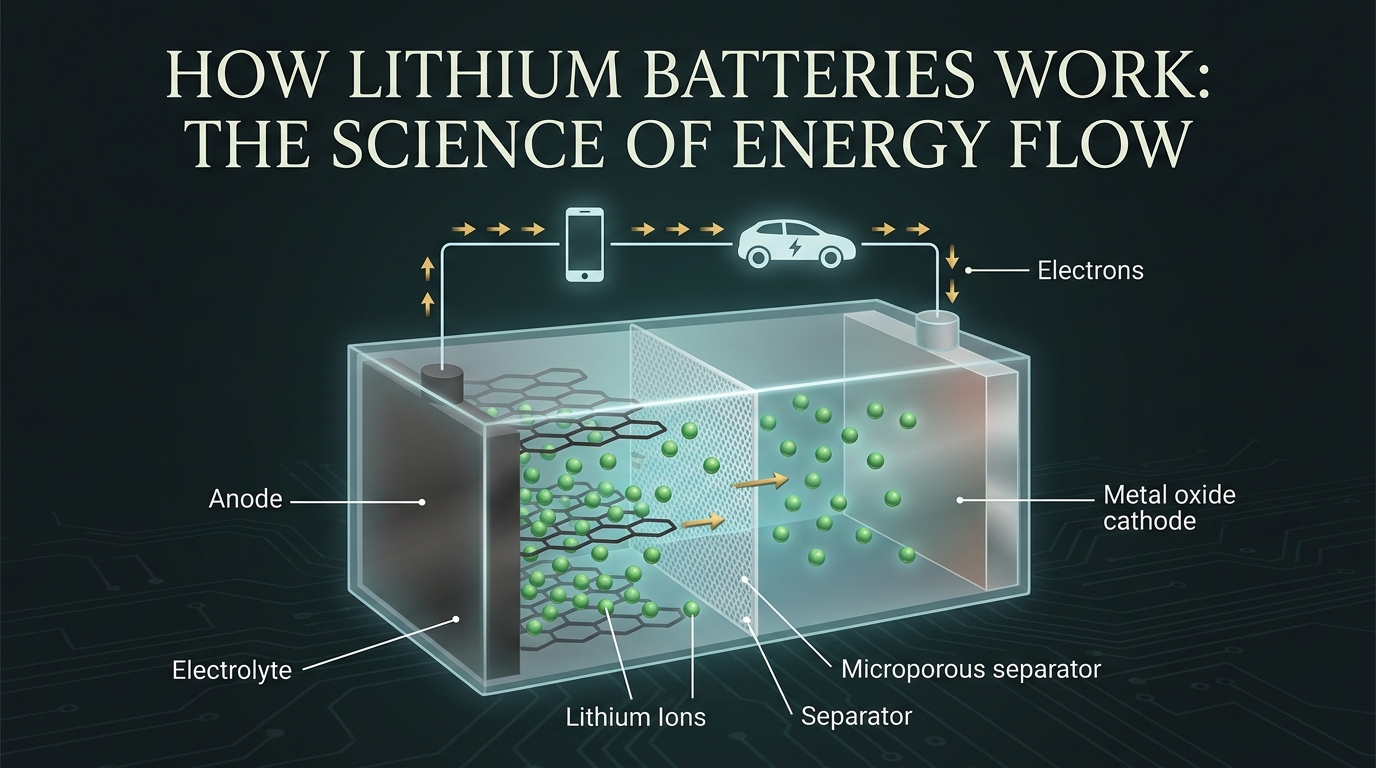
To understand how a lithium-ion cell operates, think of it as a two-sided stadium where tiny particles play a continuous game of tennis. Every cell contains four main components.
1. The Anode (The Negative Electrode)
The anode stores the lithium ions when the battery is fully charged. Manufacturers usually make the anode out of carbon material, specifically graphite. The graphite acts like a microscopic sponge, holding the lithium atoms securely in place.
2. The Cathode (The Positive Electrode)
The cathode determines the core performance, voltage, and safety of the battery. It consists of a lithium metal oxide compound. Common varieties include Lithium Cobalt Oxide (LCO) or Lithium Iron Phosphate (LiFePO4). The cathode accepts the lithium ions when the battery discharges.
3. The Electrolyte
The electrolyte is the chemical medium that fills the space between the electrodes. It usually consists of lithium salts dissolved in organic solvents. The electrolyte acts as a liquid highway, allowing lithium ions to flow smoothly back and forth.
4. The Separator
The separator is a micro-porous plastic film placed exactly between the anode and cathode. It allows tiny lithium ions to pass through freely but blocks the bulky electrons. This blocking action is crucial; if the anode and cathode touch directly, the battery will short-circuit and potentially catch fire.
The Science: How Lithium Batteries Work (Step-by-Step)
The entire operation relies on electrochemistry. The basic principle is simple: electrons flow through your device to power it, while lithium ions balance the charge inside the battery.
The Discharge Cycle (Powering Your Device)
When you unplug your phone and start browsing, the battery discharges:
- Chemical reactions release electrons at the negative anode.
- These electrons travel through your phone’s internal circuits, creating an electrical current that powers the screen and processor.
- Simultaneously, inside the battery, the lithium atoms lose an electron and become positively charged lithium ions.
- These ions swim through the liquid electrolyte and pass through the separator to reach the positive cathode.
The Charge Cycle (Recharging the Battery)
When you plug your device into a wall outlet, the process reverses completely:
- The external electricity forces electrons back into the negative anode.
- Inside the cell, the lithium ions migrate away from the cathode, pass through the separator, and wedge themselves back between the graphite layers of the anode.
- The cell restores its chemical potential energy, ready to power your device again.
Main Types of Lithium Batteries and Their Uses
Not all lithium batteries use the exact same ingredients. Altering the chemical composition of the cathode shifts the performance characteristics dramatically.
Comparison of Popular Lithium Battery Chemistries
| Battery Chemistry | Energy Density | Lifespan (Cycles) | Safety Profile | Common Use Cases |
|---|---|---|---|---|
| Lithium Cobalt Oxide (LCO) | High | 500 - 1,000 | Moderate | Smartphones, Laptops, Cameras |
| Lithium Iron Phosphate (LiFePO4) | Moderate | 2,000 - 5,000+ | Excellent | Solar Inverters, Electric Buses, RVs |
| Nickel Manganese Cobalt (NMC) | Very High | 1,000 - 2,000 | Good | Tesla EVs, Power Tools, E-bikes |
Pros and Cons of Lithium Batteries
While lithium technology revolutionized portable tech, it features distinct tradeoffs that engineers continually work to improve.
The Advantages (Pros)
- High Energy Density: They pack double or triple the power of nickel-cadmium batteries of the same weight.
- No Memory Effect: You do not need to discharge them fully before plugging them back in.
- Low Self-Discharge: They lose only about 1–2% of their stored charge per month when sitting idle on a shelf.
- High Voltage output: A single cell delivers around 3.2V to 3.7V, meaning you need fewer cells to power big machinery.
The Disadvantages (Cons)
- High Upfront Cost: Extracting lithium, cobalt, and nickel requires expensive mining and processing infrastructures.
- Sensitivity to Extremes: Freezing temperatures reduce capacity, while intense heat accelerates degradation.
- Aging: They begin degrading the moment they leave the factory floor, regardless of use.
Why Do Lithium Batteries Degrade Over Time?
Have you noticed your two-year-old smartphone barely survives until lunchtime? This happens because of unavoidable chemical wear.
Every time lithium ions move back and forth, they trigger minor secondary chemical reactions. Over hundreds of cycles, a thin layer called the Solid Electrolyte Interphase (SEI) grows thick on the anode. This layer acts like rust on a pipe, trapping free lithium ions and permanently locking them out of commission.
Furthermore, charging your battery to 100% or draining it to 0% creates high mechanical stress inside the microscopic structures of the electrodes, causing them to crack over time.
Safety First: Preventing Thermal Runaway
You have likely seen viral videos of hoverboards or e-bikes bursting into fierce flames. This phenomenon is called thermal runaway.
Thermal runaway happens when an internal short-circuit generates rapid heat. If the internal temperature surpasses a critical threshold, the chemicals inside begin to decompose, releasing oxygen and flammable gases. This creates a self-sustaining fire loop that burns incredibly hot and is difficult to extinguish with water.
To prevent this, every modern lithium battery pack features a Battery Management System (BMS). The BMS functions as an internal electronic brain, constantly monitoring the voltage, temperature, and current flow to shut down the cell safely if things go wrong.
Expert Tips to Maximize Your Battery Lifespan
You cannot stop battery aging, but you can slow it down dramatically by following these industry practices:
- Avoid the Extremes (The 20-80 Rule): Try to keep your laptop or phone battery charged between 20% and 80%. Leaving your device plugged in at 100% all night subjects the cell to high-voltage stress.
- Say No to Fast Charging Overnight: Fast chargers pump massive currents into the cells, creating localized heat. Use slow chargers for overnight sessions.
- Keep Things Cool: Never leave your mobile phone on a car dashboard under direct summer sunlight. Heat is the ultimate killer of lithium-ion chemistry.
- Store at Half-Capacity: If you plan to store an electric bike or camera battery for months, charge it to roughly 50% first. Storing a battery completely empty can permanently ruin its ability to hold a charge.
Frequently Asked Questions (FAQs)
1. Do lithium batteries have a memory effect?
No. Unlike older nickel-cadmium (NiCad) packs, lithium-ion batteries lack a memory effect. You can charge them at any point without affecting their future capacity.
2. Can I leave my smartphone plugged into the charger overnight?
Modern smartphones use smart chips to cut off power once they reach 100%. However, keeping the battery resting at max voltage for hours still creates minor structural stress.
3. What is the difference between lithium-ion and lithium polymer?
Lithium-ion uses a liquid or gel electrolyte wrapped in a rigid metal case. Lithium-polymer uses a dry, plastic-like polymer electrolyte inside a flexible foil pouch, allowing for thinner device designs.
4. How long does an electric vehicle (EV) lithium battery last?
Most modern EV battery packs last between 8 to 15 years, or roughly 100,000 to 200,000 miles, before their maximum capacity drops below 80%.
5. Why are lithium batteries restricted on airplanes?
Because of the risk of thermal runaway. If a damaged cell short-circuits in the cargo hold, it can cause an intense fire. This is why airlines require you to keep power banks in your carry-on luggage.
6. Can cold winter weather ruin my lithium battery?
Cold temperatures slow down the chemical reactions inside the cell, temporarily reducing its capacity and performance. However, once the battery warms back up to room temperature, its normal performance returns.
7. Are lithium batteries recyclable?
Yes, but the process is complex. Special recycling facilities can shred the cells to extract valuable elements like lithium, cobalt, and copper to use in new manufacturing loops. You should never throw them in standard household trash.
8. What does “C-rating” mean on a lithium battery?
The C-rating describes how quickly a battery can be safely discharged or charged relative to its total capacity. A 1C rating means the battery can be completely emptied in one hour.
9. Why do lithium batteries swell up?
Swelling occurs when a battery degrades from age, overcharging, or excessive heat. The liquid electrolyte decomposes, creating a buildup of internal gas that expands the protective outer pouch.
10. What is LiFePO4, and why is it popular for solar systems?
LiFePO4 stands for Lithium Iron Phosphate. It is popular because it offers incredible safety, cannot catch fire easily, and lasts for over 4,000 charge cycles, making it perfect for residential solar systems.
Conclusion and Actionable Advice
Lithium batteries are a cornerstone of modern green energy. By understanding the dance of lithium ions between the anode and cathode, you can control the health of your gear.
To maximize your investments, treat your batteries like living assets. Avoid extreme heat, use the 20-80% charging rule, and match the right chemistry to your needs—such as opting for LiFePO4 when building a home solar array.
By applying these small changes, you will extend the operational lifespan of your daily tech, save money on replacements, and reduce electronics waste worldwide.

2 Reply on “How Lithium Batteries Work: The Ultimate Guide (2026)”