
Do Lithium Batteries Degrade When Not in Use? Storage & Calendar Aging Explained
Table of Contents
- Quick Answer: Yes, They Degrade — But Slowly If You Store Them Right
- Your Battery Has Two Clocks: Cycles and Calendar
- What Calendar Aging Actually Does Inside the Cells
- Storage Charge Level: Why 40–
- How Long Can a Lithium Battery Safely Sit Unused?
- The Correct Storage Procedure, Step by Step
- Waking Up a Battery After 6–12 Months in Storage
- How Storage Abuse Shows Up Later
- Pakistan’s Storage Reality Check</lUnfortunately, that is not how batteries work. A lithium battery degrades whether you use it or not. The chemical reactions inside never fully stop; they only slow down. Leave a battery sitting in the wrong conditions for a year, and you can come back to noticeably less capacity than you started with — sometimes dramatically less.
The good news: calendar aging is slow, predictable, and largely within your control. This guide explains what degrades a battery that just sits, the two storage mistakes that do most of the damage, exactly how to store a battery correctly, and what to do with one that has already been sitting for months. If you store batteries in Pakistan — where the “cool, dry room” advice collides with 45°C summers — there is a reality chec
Storage charge level What happens during storage Verdict 100% (full) Maximum voltage stress; SEI growth and electrolyte oxidation run fastest; capacity The Hidden Thief: BMS and ParasiStep 2: Disconnect everything.
Remove all loads, chargers, inverters, and solar connections from the terminals. The bConclusionA lithium battery does not need to be used to grow old — it only needs time, voltage, and heat. Calendar aging is always running in the background, and the storage conditions you choose decide whether it crawls or sprints.The entire strategy fits on an index card: store at half charge, keep it cool and dry, disconnect everything, and check it every few months. Fifteen minutes of procedure protects a purchase worth tens of thousands of rupees. Skip it, and the battery spends its lifespan achieving nothing.If your battery has already spent a year in a hot storeroom at full charge, do not despair — but do test it honestly before trusting it with critical loads, and store it properly from today. And if you are planning a new purchase, our 2026 lithium battery buying guide for solar will help you choose a battery worth taking care of.Sources & Further Reading- MDPI Applied Sciences — Study on Influencing Factors of Calendar Aging and Cycle Aging of LFP Batteries
- Beijing Institute of Technology — From Calendar Aging to Cycle Degradation: SOC-Dependent Structural Evolution in LiFePO4/Graphite Batteries (research record; published 1 Apr 2026)
- Heated Battery — Do LiFePO4 Batteries Degrade If Not Used?
- LiFePO4-Battery.com — How to Store LiFePO4 Batteries Long Term
- Anern — LiFePO4 Battery Storage: Stop Parasitic Drain
- eHam.net — Sealed Lead-Acid Battery Fact Sheet (lead-acid self-discharge reference)
Last updated: October 2026. Battery specifications and guidance change over time — always verify against your battery’s datasheet before storing.Is it bad to store a lithium battery fully charged?Yes, for long-term storage. High voltage accelerates the parasitic reactions that cause calendar aging — research shows storage at 100% charge degrades cells several times faster than storage at 50%. Fully charged is fine for days or weeks; for months, bring it down to half.Can a dead lithium battery be revived after long storage?Sometimes. If the BMS entered sleep mode from low voltage, a charger with a recovery/wake-up mode can often bring it back. But any capacity lost to calendar aging during that time is permanent — revival restores function, not lost amp-hours. A battery that sat deeply discharged for many months may have suffered irreversible cell damage.Should I store my solar battery differently in winter?Winter in Pakistan’s plains is actually good for storage — 10–20°C ambient temperatures slow aging nicely. The main winter risk is neglect: set a reminder to check voltage mid-season, and never charge a battery that is below freezing without warming it first.Do lead-acid batteries degrade in storage faster than lithium?Yes, significantly. Lead-acid batteries self-discharge at roughly 3–8% per month (versus 1–3% for LiFePO4) and suffer sulfation — permanent plate damage — if left discharged. A lead-acid battery needs topping up every 1–2 months in storage; a lithium battery needs a check every 3–4 months.Frequently Asked QuestionsDo lithium batteries degrade if not used?Yes. Even with nothing connected, internal chemical reactions (calendar aging) slowly consume capacity. The rate depends mainly on storage charge level and temperature — a half-charged battery in a cool room loses very little in a year; a fully charged battery in heat loses far more.What is the best charge level for storing a lithium battery?40–60% charge — roughly half full. This minimizes voltage stress on the cells while leaving a comfortable margin above deep discharge. Avoid storing at 100% or near 0% for extended periods.How long can a LiFePO4 battery sit unused?Up to 12 months with minimal loss if stored at 40–60% charge in a cool room with voltage checks every 3–4 months; up to around 2 years is sometimes cited as an outer limit under ideal conditions. Beyond a year without checks, you risk parasitic drain pulling the battery into deep discharge.Does a lithium battery lose charge when turned off?Slowly, yes — typically 1–3% per month for LiFePO4 from chemical self-discharge. But the BMS and any connected electronics can drain considerably more, which is why disconnecting everything (or using a storage/shelf mode) matters more than most people realize.Pakistan’s Storage Reality CheckStandard storage advice says “cool, dry room at 10–25°C.” In much of Pakistan, that room does not exist for half the year. Here is how to adapt the rules to local reality:The hot storeroom problem. Spare batteries commonly end up in storerooms under metal roofs, rooftop boxes, or unventilated side rooms — exactly the places that hit 40–50°C in summer. This is the worst common storage scenario: heat plus (usually) a full charge, since people store batteries the way they last used them — fully charged. If your only storage spot runs hot, at minimum store at 40–50% charge instead of full; the lower voltage stress partially offsets the heat penalty. Better: move the battery to the coolest room in the house, even if it is less convenient.Seasonal solar batteries. Many households use solar heavily in summer and barely in winter. A battery that idles from November to February is a storage battery for four months. Winter temperatures in the plains are actually ideal for storage (10–20°C) — the risk is forgetting the battery entirely. Set the mid-winter voltage check reminder; four months of BMS parasitic drain with no attention is how good batteries quietly die.UPS batteries that rarely cycle. Pakistan’s grid has improved in many areas, which paradoxically creates a storage problem: UPS batteries that used to cycle daily during load shedding now sit at float charge for weeks. A battery permanently floating at 100% in a warm room is experiencing the worst calendar-aging combination while doing “nothing.” If your UPS supports it, occasionally exercising the battery (a deliberate discharge to ~50% and recharge, every month or two) breaks up the permanent full-charge state. At minimum, make sure the UPS uses a proper lithium charge profile, not a lead-acid one.Monsoon humidity. The July–August monsoon pushes indoor humidity high in much of the country. For stored batteries, humidity above ~60% sustained can corrode terminals and connections over months. A dry spot matters as much as a cool one — and a quick terminal inspection during your quarterly check catches corrosion early.The buying angle. If you are buying a spare battery now for later, factor storage into the purchase: buy closer to when you need it. Every month a battery sits in a hot shop or storeroom before its first use is calendar aging you paid full price for. Our buying guide for solar lithium batteries and battery lifespan tips cover what else to weigh before buying.4. Charge slowly with the correct charger. Use a charger with the proper lithium profile for your chemistry — never a lead-acid charger unless it has a manufacturer-approved lithium mode. A gentle charge rate (0.2–0.5C) for the first full charge is kinder to cells that have been idle.5. Verify cell balance. If your BMS has Bluetooth or a display, check that cell voltages are close together (within roughly 0.1V). A long idle period can let cells drift apart; most BMS units will rebalance during a full charge, but large imbalances deserve attention.6. Run a capacity test before trusting it. Discharge the battery through a known load and measure actual delivered capacity against its rating. If it delivers close to rated capacity, it survived storage well. If it is significantly short, the shortfall is permanent calendar-aging loss — adjust your expectations (and your system sizing) accordingly rather than assuming the rating still holds.How Storage Abuse Shows Up LaterStorage damage is sneaky because it is invisible at the time and shows up months later as “the battery just isn’t what it used to be.” Here is how to recognize it:
- Permanent capacity loss. The headline symptom: the battery delivers fewer amp-hours than its rating. A battery stored a year at full charge in heat can test 10–20% below rating — capacity that will never come back.
- Voltage sag under load. Aged cells often show higher internal resistance, so voltage dips harder when a load kicks in. The inverter may cut out earlier than it used to, even though the battery “tests fine” at rest.
- Cell imbalance. Cells that drifted apart during storage may never fully reconverge. The BMS works harder, balancing takes longer, and usable capacity is limited by the weakest cell group.
- Shorter runtime in the same application. The most noticeable real-world sign: the UPS that used to give 4 hours now gives 3. If nothing else changed, suspect the storage history.
- BMS sleep/lockout. A battery drained to cutoff during storage may refuse to charge normally. This is recoverable in many cases, but it is a warning that the battery spent time in the danger zone.
None of this is fixable after the fact — calendar aging is one-way. That is exactly why the fifteen-minute storage procedure above is worth more than any recovery trick.attery should be electrically alone. If the battery has a storage/shelf mode, activate it now.Step 3: Choose the location.
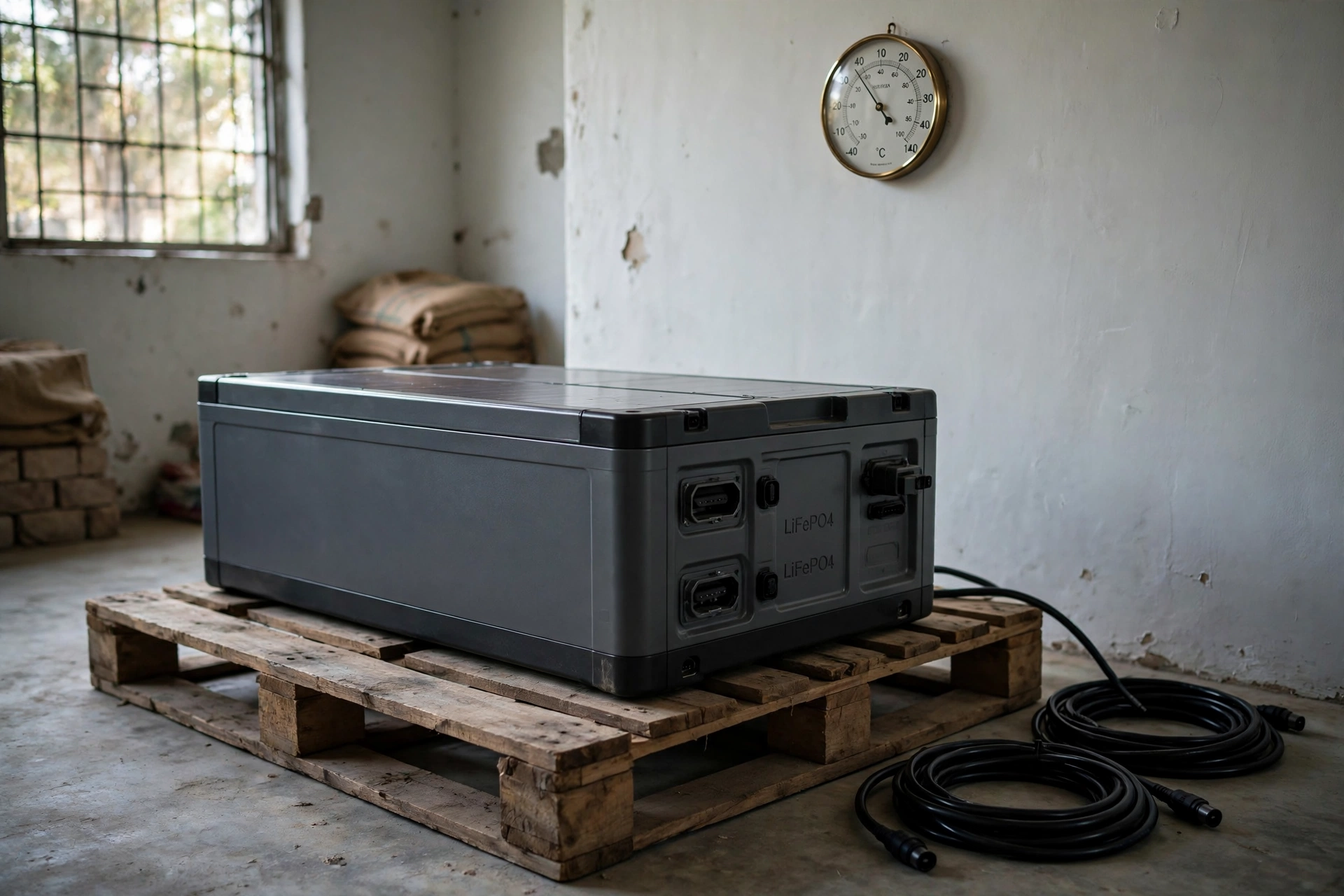
A cool, dry, ventilated indoor spot: a ground-floor room, a basement, a climate-stable part of the house. Avoid tin sheds, rooftop boxes, unventilated storerooms, and anywhere near heat sources. Keep it off bare concrete floors if the floor sweats with moisture — a wooden pallet or shelf is enough. Keep the battery away from flammable materials, as with any stored energy device.Step 4: Protect the terminals.
Cover terminals to prevent accidental short circuits — terminal caps, electrical tape, or simply ensuring nothing metal can fall across them. Clean any existing corrosion first.Step 5: Log the starting point.
Write down the date and the resting voltage (or SoC reading) on a piece of tape stuck to the battery or in your phone’s notes. This turns every future check into a meaningful comparison instead of a guess.Step 6: Set a reminder for 3–4 months out.
Check the voltage. If it is still in the 40–60% band, do nothing. If it has drifted below ~30%, charge it back to ~50% and disconnect again. This single habit prevents nearly all storage disasters.Waking Up a Battery After 6–12 Months in StorageFound a battery that has been sitting for most of a year — maybe without the ideal procedure above? Do not just hook it up to a full load. Wake it up properly:1. Inspect first. Look for swelling, case deformation, leaking fluid, corrosion on terminals, or any unusual smell. If you see swelling or damage, stop: treat it as a safety issue, not a maintenance task. (Our battery mistakes guide covers warning signs in detail.)2. Let it normalize. If the battery is cold (below ~10°C) or hot from its storage spot, let it rest at room temperature for several hours before charging. Never charge a frozen battery.3. Check the resting voltage. Compare against your battery’s voltage chart. If it reads near the low-voltage cutoff or the BMS appears to be in sleep mode (zero volts at the terminals), the BMS may need a wake-up charge — some chargers have a dedicated recovery mode for this. If the battery will not wake, consult the manufacturer or a qualified technician rather than improvising.How Long Can a Lithium Battery Safely Sit Unused?”How long” is really “how long under what conditions.” Assuming a LiFePO4 battery stored at 40–60% charge, disconnected, in reasonable temperatures:- 1 month: Essentially nothing to worry about. Capacity loss is negligible; a quick voltage check is plenty.
- 3 months: Still fine. Expect a few percent of charge drift from self-discharge. Check voltage once.
- 6 months: The point where attention starts to matter. Check voltage; top up to ~50% if it has drifted below ~30%. In warm conditions, check sooner.
- 12 months: Achievable with minimal permanent loss (low single-digit percent) if stored cool at mid-charge with periodic checks. In a hot storeroom at full charge, expect far worse.
- 18–24 months: Possible for LiFePO4 under good conditions, but you are now relying on the checks having happened. Beyond this, even well-stored batteries accumulate enough calendar aging that a capacity test is wise before trusting the battery with critical loads.
One vendor FAQ claims up to 2 years of safe storage at 50% charge and 25°C. That is plausible for LiFePO4 given the low self-discharge and slow calendar aging — but treat it as an optimistic ceiling, not a guarantee, and never as permission to skip the periodic checks.The honest summary: a lithium battery does not have an expiry date, but it does have a maintenance schedule. Respect the schedule and years of idle time cost you little. Ignore it and the battery quietly spends its lifespan while doing nothing.The Correct Storage Procedure, Step by StepHere is the full procedure. It takes about fifteen minutes, and it is the difference between a battery that wakes up healthy and one that does not.Step 1: Bring the battery to 40–60% charge.
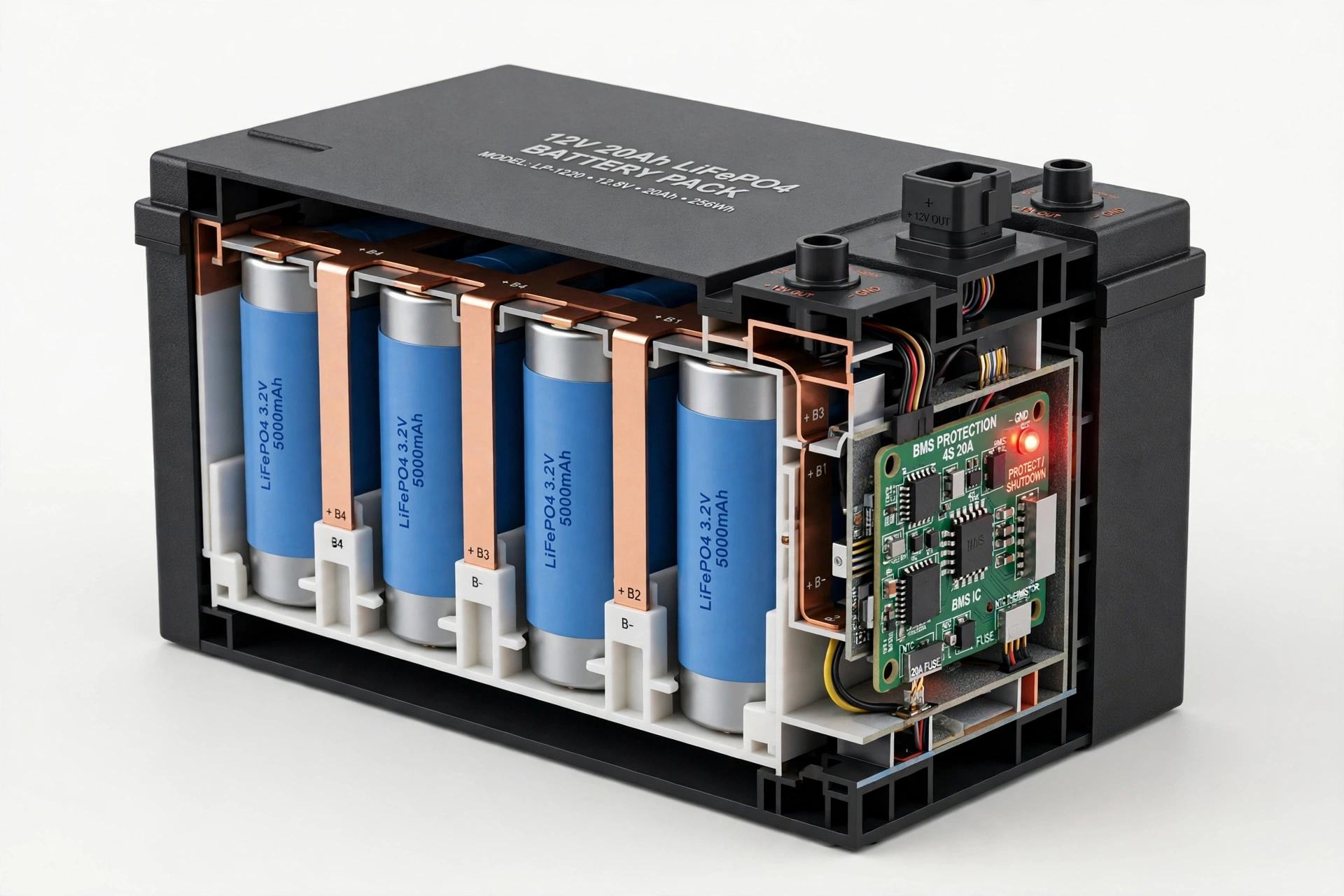
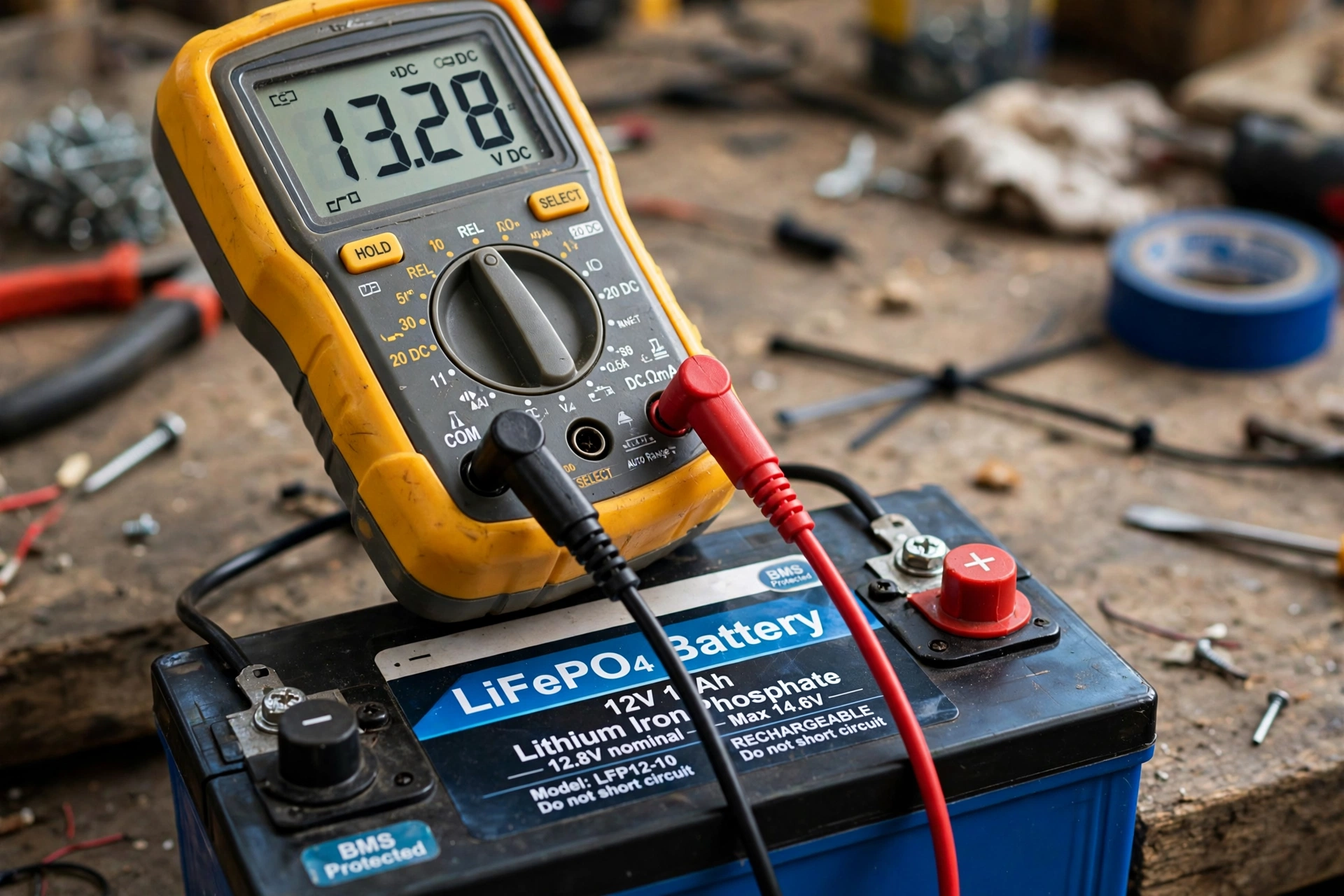
If it is full, discharge it to roughly half — run a moderate load for a while, or use your charger’s discharge/storage function if it has one. If it is low, charge it up to about half. For a 12V LiFePO4 battery, roughly 13.0–13.2V resting voltage corresponds to the middle of the range (confirm against your battery’s voltage chart, as exact figures vary by manufacturer).tic DrainHere is the storage killer most people never suspect: the battery’s own electronics.A modern lithium battery pack contains a Battery Management System (BMS) — a small circuit board that monitors cell voltages, temperature, and current. The BMS is always on, even when the battery is “off.” It draws a small current continuously: typically a few milliamps. That sounds like nothing, but do the math on a 100Ah battery with a 3mA BMS draw: 3mA × 24 hours × 30 days ≈ 2.2Ah per month — roughly another 2% monthly drain on top of chemical self-discharge. Add a Bluetooth module or display that stays active, and the drain grows further. One energy-storage analysis estimated that electronic parasitic drain accounts for 70–90% of total charge loss during storage — the chemistry is the minor leak; the electronics are the open tap.This is why “fully charged and disconnected from everything” can still go wrong: if the BMS stays powered, the battery is not truly disconnected from itself. Over six to twelve months, parasitic drain alone can drag a battery from a healthy storage charge down toward the low-voltage cutoff — and if the BMS then enters sleep or lockout mode, the battery can appear completely dead and may need specialized recovery charging.The fixes are straightforward:- Disconnect the battery from all external loads — inverter, charger, solar controller, everything. Terminals should have nothing attached.
- If your battery has a shelf/shipping/storage mode, use it. This puts the BMS into an ultra-low-power state (microamps instead of milliamps).
- For bare cells or packs where it is safe to do so, physically disconnecting the BMS eliminates the drain entirely — but only if you know what you are doing; an unprotected lithium pack has no safety net.
- Check voltage every 3–4 months regardless. If it has drifted down toward 20–30%, top it back up to the 40–60% range.
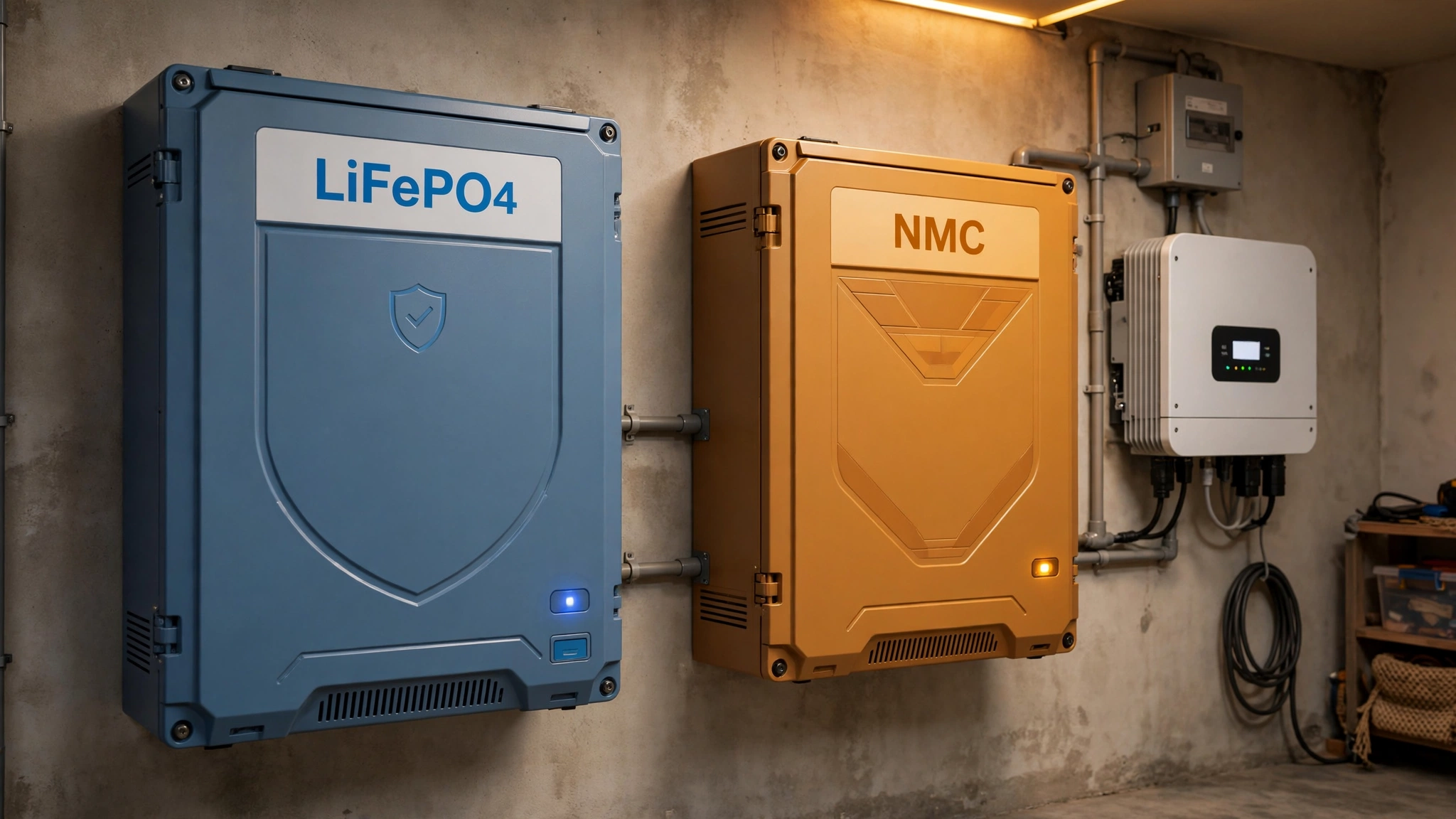
Two things stand out. First, lithium — especially LiFePO4 — is dramatically better at holding charge than lead-acid, which is one of the practical reasons people switch; our lithium vs lead-acid comparison covers the full trade-off. Second, self-discharge is only half the drain story. The other half is sneakier.
Storage temperature Estimated capacity loss over 12 months Notes 0°C ~5–7% Aging is slow, but do not charge while frozen 15–25°C ~2–3% Chemistry Typical self-discharge What it means in practice LiFePO4 (lithium iron phosphate) ~1–3% per month A half-charged 100Ah battery loses roughly 1–3Ah per month — negligible over a season NMC lithium-ion ~1–3% per month (higher when warm) Loses charge somewhat faster than LiFePO4, especially in heat Lead-acid AGM / gel ~3–5% per month Needs a top-up charge every 2–3 months in storage Flooded lead-acid ~5–8% per month Can go flat in a few months; also risks sulfation while sitting discharged The target range 35°C ~10–15% Typical hot-room penalty 40°C+ ~18–22% Severe; avoid sustained storage here These are vendor-published estimates, not laboratory measurements — treat them as showing the shape of the relationship (loss climbs steeply with temperature) rather than exact predictions for your battery. But the shape is what matters for decisions: moving a stored battery from a 40°C storeroom to a 25°C room is one of the highest-value things you can do for it.
For the full temperature picture — including charging and discharge limits, not just storage — see our lithium battery temperature range guide for hot climates.
Self-Discharge Rates by Chemistry
Separate from calendar aging (permanent capacity loss) is self-discharge: the slow loss of charge while a battery sits. Self-discharge is reversible — you get the charge back when you recharge — but it matters because an unattended battery can drift from a safe storage charge down into the danger zone over months.
Typical self-discharge rates, as reported across manufacturer specs and industry sources:
One manufacturer-oriented analysis estimated that storing at 100% charge in warm conditions can cause roughly 15% capacity loss in a year, versus 2–3% at 50% charge at room temperature — a several-fold difference from charge level alone. Treat those figures as illustrative rather than exact (they come from industry sources, not controlled lab data), but the direction and rough magnitude are consistent with the peer-reviewed research.
A useful rule of thumb: the longer the storage, the closer to 40% you should aim. For one to three months, 50–60% is fine. For six to twelve months, 40–50% gives you more headroom against self-discharge drift without parking the battery at a stressful voltage.
Storage Temperature: The Other Half of the Equation
Charge level decides how stressed the battery is; temperature decides how fast the stress does damage. The rule of thumb used across the battery industry is that unwanted chemical reactions roughly double in speed with every 10°C rise. A battery stored at 35°C ages roughly twice as fast as the same battery at 25°C, and roughly four times as fast as one at 15°C.
For LiFePO4 storage, the practical guidance from manufacturers and industry sources converges on:
- Ideal: 10–25°C — a cool indoor room. Calendar aging runs at its slowest.
- Acceptable: 0–35°C — fine for shorter storage periods with more frequent checks.
- Avoid: above 35–40°C sustained — aging accelerates sharply; capacity loss over a year can be several times higher than at room temperature.
- Avoid: below freezing for charging — storing cold is generally safe, but never charge a frozen battery; let it warm above 0°C first.
Industry estimates for annual capacity loss at different storage temperatures (LiFePO4, stored at moderate SoC) illustrate the scale:
loss several times faster than at half charge
Worst — avoid for storage 80% Still elevated voltage stress; meaningfully better than 100% but far from ideal Poor for long storage 40–60% (half) Minimum electrode stress; slowest calendar aging; comfortable safety margin above deep discharge Ideal storage range 20% Low stress, but thin margin — months of self-discharge can drag it into the danger zone Risky without monitoring Near 0% (empty) Risk of copper dissolution and BMS sleep/lockout; possibly unrecoverable Dangerous — never store empty Research consistently identifies the same two accelerators for these reactions: high state of charge and high temperature. A peer-reviewed study on LFP calendar aging (published in MDPI Applied Sciences, December 2025) found that calendar aging is strongly governed by storage SoC and temperature, with higher values of both accelerating capacity fade through enhanced SEI growth. A Beijing Institute of Technology study went further: LFP cells stored at 45°C for 100 days at 100% charge degraded far more severely than identical cells stored at 50% charge at the same temperature — and the damage carried over into later cycling.
The practical translation is simple. Storing a battery is not a passive act; the charge level and temperature you store it at are actively deciding how fast it ages. If the chemistry fundamentals interest you, our guide on how lithium batteries work explains cells, the SEI layer, and the BMS in plain language.
Storage Charge Level: Why 40–60% Is the Rule
If you take one thing from this article, make it this: do not store a lithium battery fully charged. And do not store it empty either. The sweet spot is 40–60% charge — roughly half full.
Why? It comes down to voltage stress. At 100% charge, every cell sits at its maximum voltage. High voltage stresses the electrolyte and drives the parasitic reactions described above at their fastest rate. At the other extreme, a deeply discharged battery risks dropping so low that the copper current collectors inside begin to dissolve — damage that is permanent. The middle of the range is where both electrode and electrolyte are under the least stress.
Here is how different storage charge levels compare:
This matters because the two clocks respond to different things. Cycle aging cares about depth of discharge, charge rates, and how many cycles you run. Calendar aging cares about state of charge and temperature while the battery sits. You can have a battery with zero cycles on it that has still lost meaningful capacity — if it spent a year fully charged in a hot room.
Understanding this split is also the key to the full longevity picture: if you want to know how long LiFePO4 batteries actually last in real-world use, you have to account for both clocks, not just the cycle count on the datasheet.
What Calendar Aging Actually Does Inside the Cells
You do not need a chemistry degree to store a battery correctly, but a one-minute look inside helps everything else make sense.
A lithium cell stores energy by shuttling lithium ions between two electrodes through an electrolyte. That is the useful reaction. But it is not the only reaction happening. Alongside it, parasitic side reactions constantly nibble at the system:
- SEI layer growth. The anode is protected by a thin film called the solid electrolyte interphase (SEI). It forms during the battery’s first charges and is essential — it prevents the electrolyte from reacting destructively with the anode. But the film never stops growing. It grows a little every day, and every bit of growth permanently consumes usable lithium. Heat and high voltage make it grow faster.
- Electrolyte decomposition. Small amounts of electrolyte break down over time, producing gas and byproducts. This is slow at room temperature and moderate charge, but accelerates sharply in heat.
- Loss of lithium inventory. Both of the above consume lithium ions that would otherwise be available to carry charge. This is the direct mechanism of capacity loss: fewer working ions, less usable energy.
- Storage charge level. A battery stored at 100% charge ages several times faster than one stored at 40–60%. This is the single biggest controllable factor.
- Storage temperature. Heat accelerates every aging reaction. A battery stored in a 40°C room can lose in one year what a battery in a 20°C room loses in several.
A LiFePO4 battery stored correctly — roughly half-charged, in a cool room, disconnected from all loads — typically retains well over 90% of its capacity after a year. The same battery stored fully charged in a hot storeroom can lose a far larger share in the same time. One of the most common mistakes that damage lithium batteries early is treating storage as “set and forget.”
Your Battery Has Two Clocks: Cycles and Calendar
Most battery talk focuses on cycle life: how many charge-discharge cycles a battery survives before its capacity drops. That is only half the story.
Every lithium battery actually ages on two clocks running simultaneously:
- Cycle aging — wear from being charged and discharged. Each cycle stresses the electrodes slightly, and the damage accumulates with every cycle.
- Calendar aging — wear from simply existing. Even sitting on a shelf with nothing connected, the battery’s internal chemistry keeps reacting at a low background rate.
Here is the part people miss: the two clocks do not pause for each other. A battery that cycles daily still suffers calendar aging between cycles, and a battery that never cycles still ages on the calendar clock alone. For a solar battery that cycles every day, cycle aging usually dominates. For a spare or seasonal battery that sits for months, calendar aging is the only thing happening — and it is the entire story.
k section just for you.
Quick Answer: Yes, They Degrade — But Slowly If You Store Them Right
Do lithium batteries degrade when not in use? Yes. The process is called calendar aging: chemical side reactions inside the cells continue even with zero load, permanently consuming a small amount of capacity over time.
How fast depends on two things above all else:
i>
- Frequently Asked Questions
- Conclusion
Introduction
You bought a spare lithium battery “for later.” Or your solar battery sits idle through the mild winter months. Or the UPS battery in your shop rarely cycles because the power barely goes out. It has been months since the battery did any real work — so it should be fine, right? After all, nothing was used.
60% Is the Rule
- Storage Temperature: The Other Half of the Equation
- Self-Discharge Rates by Chemistry
- The Hidden Thief: BMS and Parasitic Drain
One thought on “Do Lithium Batteries Degrade When Not in Use? Storage & Calendar Aging Explained (2026)”