Lithium Battery Lifespan in Hot Climates: Pakistan Heat Guide
Table of Contents
- Quick Answer: Lithium Battery Temperature Range
- Temperature Specs by Chemistry: LiFePO4 vs NMC vs Lead-Acid
- The Charging Window Is What Actually Matters
- What Heat Does Inside Your Battery
- Pakistan’s Summer: What Your Battery Really Faces
- Where to Install Your Battery: Placement Guide for Hot Climates
- Low-Cost Cooling: 8 Practical Ways to Beat the Heat
- Summer Maintenance Calendar: May to September
- Warning Signs of Heat Damage
- Buying a Battery for a Hot Climate: What to Check
- Frequently Asked Questions
- Conclusion
Introduction
If you own a solar battery in Pakistan, summer is your battery’s hardest season. While you are switching on fans and air conditioners, your battery is sitting somewhere — a storeroom, a garage, a rooftop shed — quietly cooking. Ambient temperatures in Lahore, Multan, and Gujranwala routinely cross 44–46°C in June, and in Sindh’s hottest cities they have touched 50–51°C during recent heatwaves. Inside a sun-baked metal enclosure, it gets hotter still.
Most battery guides mention temperature in passing: “avoid extreme heat.” That advice is useless when extreme heat is your normal weather for four months a year. This guide is different. It gives you the actual temperature specifications for lithium and lead-acid batteries, explains what heat does inside the cells, and — most importantly — tells you exactly what to do about it: where to install the battery, how to cool it cheaply, and how to maintain it through a Pakistani summer.
If you are wondering how long LiFePO4 batteries last in normal conditions, that is 10–15 years. In sustained heat with poor installation, it can be far less. This article is about making sure heat does not steal those years.
Quick Answer: Lithium Battery Temperature Range
A typical LiFePO4 (lithium iron phosphate) battery has three temperature windows:
- Charging: 0°C to 45°C (some manufacturers rate up to 50–55°C — check your datasheet)
- Discharging: -20°C to 60°C
- Long-term storage: -10°C to 35°C
- Optimal for lifespan: 15°C to 35°C
The critical number for Pakistan is the charging window. A battery that can discharge at 60°C may still be damaged by charging at 48°C. Since a solar battery charges every single day, your installation location must stay within the charging range — not just the wider discharge range. Everything below explains why, and how to achieve it when the air outside is 46°C.
Temperature Specs by Chemistry: LiFePO4 vs NMC vs Lead-Acid
Not all batteries tolerate heat equally. Here are the typical temperature specifications from manufacturer datasheets, so you can compare what you own — or what you are about to buy.
| Temperature window | LiFePO4 (LFP) | NMC Lithium | Deep-Cycle Lead-Acid |
|---|---|---|---|
| Charging | 0°C to 45°C (some: up to 50–55°C) | 0°C to 45°C | 0°C to 40°C (approx.) |
| Discharging | -20°C to 60°C | -20°C to 60°C | -20°C to 50°C (approx.) |
| Storage (long-term) | -10°C to 35°C | -20°C to 45°C (short-term) | 10°C to 25°C |
| Optimal for lifespan | 15°C to 35°C | 15°C to 35°C | 20°C to 25°C |
| Heat tolerance | Good — thermally stable chemistry | Moderate — degrades faster in heat | Poor — lifespan halves per 10°C above 25°C |
Typical ranges compiled from manufacturer datasheets and manuals; individual products vary — always check your specific battery’s datasheet. Lead-acid figures are approximate industry guidance.
Three things stand out from this table:
First, lithium beats lead-acid in heat by a wide margin. The most widely cited rule for lead-acid batteries — reported via Battery University and repeated across the industry — is that lifespan drops by roughly 50% for every 10°C above 25°C. A tubular battery that might last 5 years at 25°C can be down to 2–3 years in a sustained 35–40°C battery room. Heat also accelerates water loss in flooded batteries and corrosion of the positive plates. If you still run lead-acid batteries, heat management matters even more than it does for lithium. Our lithium vs lead-acid comparison covers the full trade-off.
Second, LiFePO4 handles heat better than NMC. Both are lithium-ion, but the iron-phosphate chemistry is inherently more thermally stable. NMC’s cycle life already runs shorter than LiFePO4’s, and elevated temperatures widen that gap — published LFP aging research found that at 45–60°C, degradation is dominated by accelerated side reactions, while NMC chemistries additionally face greater thermal stability concerns. For a stationary battery in a hot climate, LiFePO4 is the safer chemistry. (For the full lifespan picture, see our guide on how long LiFePO4 batteries last.)
Third, every chemistry agrees on one thing: 15–35°C is the sweet spot. The closer you keep your battery to that band, the closer you get to the datasheet lifespan. The further above it you go, the faster you pay in years.
The Charging Window Is What Actually Matters
Here is the single most misunderstood point about battery temperature specs — and the one that destroys batteries in Pakistan.
Datasheets lead with the wide discharge range (-20°C to 60°C) because it looks impressive. But a solar battery does not just discharge. It charges every day, usually during the hottest hours: solar panels peak between 11 AM and 3 PM, exactly when ambient temperatures peak. So the number that governs your installation is the charging window: typically 0°C to 45°C for LiFePO4.
What happens above that? Two problems:
- Accelerated degradation. Charging at high temperature speeds up the parasitic chemical reactions inside the cell. A study from the Beijing Institute of Technology (published 1 April 2026, per its research record) stored LFP cells at 45°C and found that high state-of-charge storage at that temperature caused severe capacity degradation and physical deterioration of the cells — damage that then carried over into subsequent cycling. In plain terms: baking a full battery in heat does damage that does not undo itself.
- BMS cutoffs and lost solar hours. Quality batteries include a Battery Management System that refuses to charge above its temperature limit — commonly 45–50°C. On the hottest afternoons, your BMS may simply stop accepting charge. Your panels are producing peak power, and your battery is refusing it. That is lost energy and deeper evening discharges, which wear the battery further.
The rule: spec your installation location against the charging window (0–45°C), never the discharge range. If the spot where your battery sits exceeds 45°C on summer afternoons, the location is wrong — no matter what the discharge spec says.
What Heat Does Inside Your Battery
Understanding the mechanism helps you take the right countermeasures. Here is what sustained heat does, in plain language, for each chemistry.
Lithium batteries: faster chemistry, in the bad sense
Inside a lithium cell, the useful reactions (charging and discharging) are not the only ones happening. Parasitic side reactions constantly nibble at the electrolyte and electrodes, and heat accelerates them. Published research on LFP cell aging found that elevated temperature consistently accelerated capacity loss because these thermally activated side reactions dominate at high temperatures. The protective SEI layer on the anode grows thicker and consumes usable lithium faster; at 45°C and above, researchers observed gas formation from electrolyte breakdown.
Two factors multiply the damage:
- High state of charge + heat is the worst combination. The Beijing Institute of Technology study found that LFP cells stored at 100% charge at 45°C for 100 days degraded far more severely than cells stored at 50% charge at the same temperature. A solar battery that hits 100% by noon and then sits fully charged through a 44°C afternoon is living in exactly this worst case.
- Heat damage is cumulative and irreversible. Unlike a deep discharge, which the battery recovers from, capacity lost to heat-driven side reactions does not come back. Every hot summer permanently trims the battery’s remaining life.
Lead-acid batteries: corrosion, water loss, and the halving rule
Heat hits lead-acid batteries through different mechanisms but with even harsher results:
- Grid corrosion accelerates. Above 25°C, corrosion of the positive plates speeds up dramatically — the widely cited industry figure is a ~50% lifespan reduction per 10°C rise.
- Water loss increases. Flooded batteries lose water faster in heat through evaporation and gassing during charging. Let the electrolyte level drop below the plates and permanent damage follows.
- Self-discharge doubles. Self-discharge rates roughly double with every 10°C rise, so a battery sitting in a hot storeroom drains itself noticeably faster.
The practical consequence: a lead-acid battery bank in an unventilated Pakistani storeroom in July is aging several times faster than its rated life assumes. This is one of the strongest arguments for switching to lithium in hot climates — and one of the mistakes that kill lithium batteries early is assuming lithium is immune to heat. It is tougher, not invincible.
Background reading: If you want the chemistry fundamentals behind all of this, our ultimate guide to how lithium batteries work explains cells, the SEI layer, and the BMS in plain language.
Pakistan’s Summer: What Your Battery Really Faces
Generic advice says “keep batteries below 40°C.” Let us look at what that means against actual Pakistani weather.
Recorded summer temperatures in recent heatwaves (reported by Pakistani media and the Pakistan Meteorological Department):
| City / Region | Reported peak |
|---|---|
| Jacobabad (Sindh) | 50–51°C |
| Larkana (Sindh) | 51°C |
| Sukkur (Sindh) | 50°C |
| Dera Ismail Khan (KP) | 48.4°C |
| Lahore (Punjab) | 46°C (season’s hottest day) |
| Multan (Punjab) | 46°C |
| Faisalabad / Bahawalpur | 45°C |
Peaks reported during recent heatwave events; typical June highs in the plains run 42–47°C.
Now add the installation reality. A battery does not experience the meteorological temperature — it experiences the temperature where it is installed:
- Tin sheds and rooftop enclosures in direct sun can run roughly 10–15°C hotter than ambient air. A battery box on a rooftop in Multan on a 46°C day can plausibly see 55–60°C inside — beyond the charging limit of virtually every lithium battery sold.
- Unventilated storerooms with no airflow trap heat through the afternoon and release it slowly at night. Night-time lows in interior Sindh during heatwaves have stayed near 30–34°C, giving the battery almost no cool recovery period.
- Load shedding compounds the stress. Heatwaves in Pakistan coincide with heavier power cuts. That means deeper daily discharges (more cycling) exactly when the battery is hottest — heat damage plus cycle wear at the same time.
The honest summary: in much of Pakistan, from May to August, a poorly placed battery spends weeks each year operating at or above its rated charging-temperature limit. Placement is not a minor optimization here — it is the difference between a battery that lasts a decade and one that dies in three years.
Where to Install Your Battery: Placement Guide for Hot Climates
Where you put the battery matters more than which brand you buy. Follow this placement hierarchy, best to worst:
Best: cool indoor room, ground floor, shaded side of the house
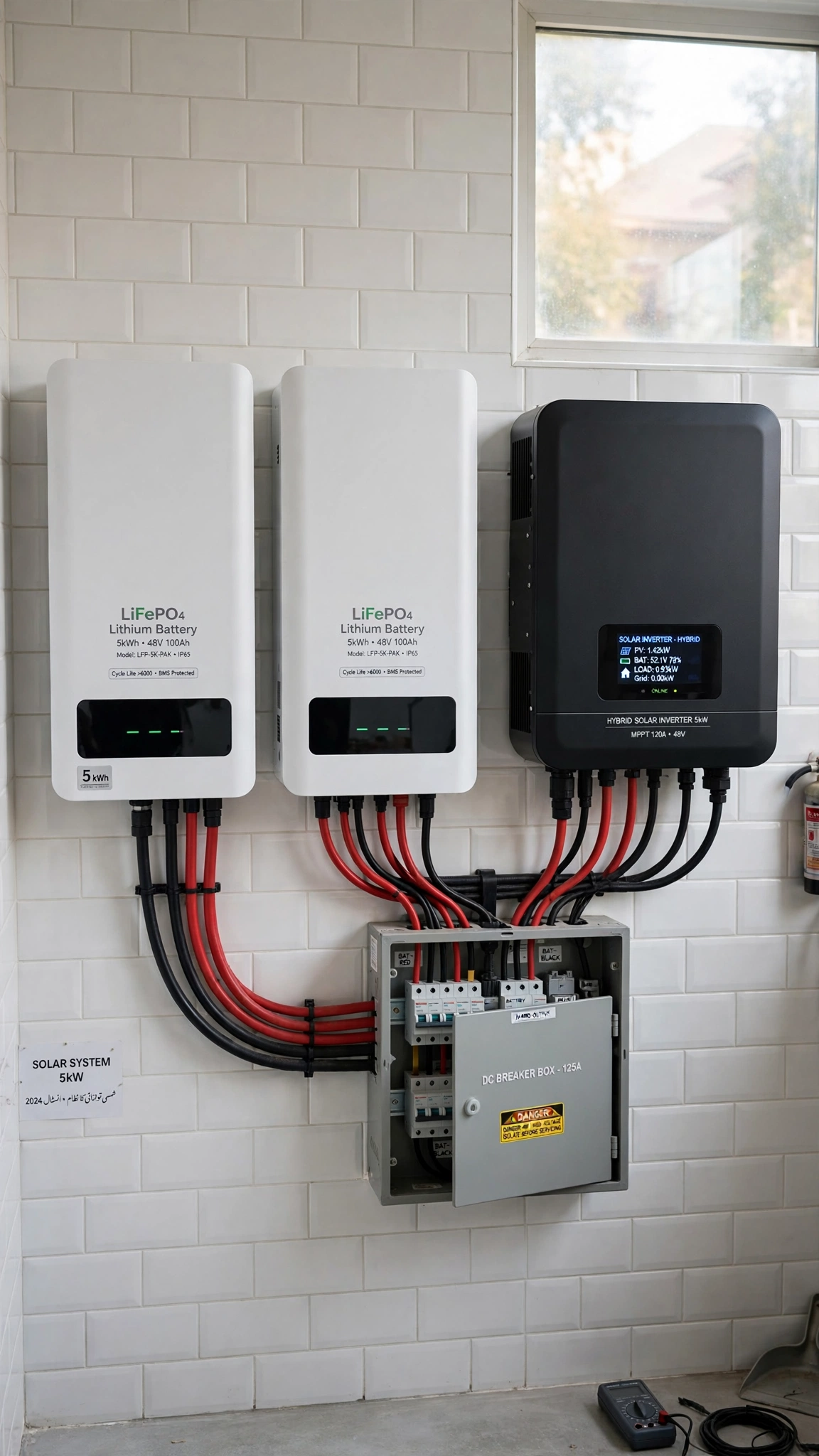
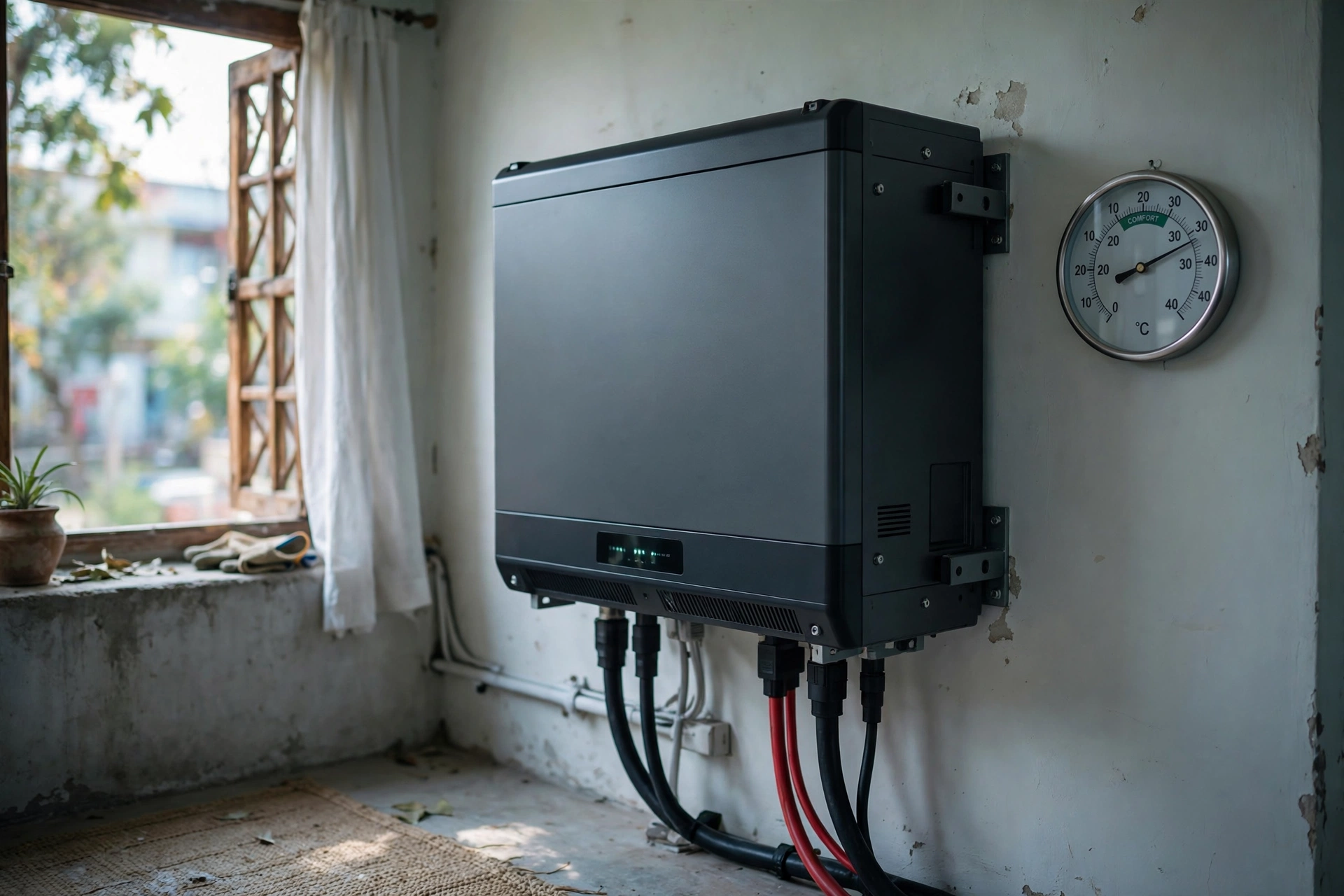
- Choose the coolest room available — typically a ground-floor room on the shaded (north-facing, in Pakistan) side. Indoor rooms in Pakistani homes commonly stay 5–10°C cooler than outdoors in summer, especially with thick walls.
- Keep the battery off the floor on a stand or wall mount, away from direct sunlight through windows.
- Maintain the manufacturer’s clearance on all sides (usually 10–20 cm) so air circulates around the casing.
- Keep it away from heat sources: UPS units, inverters, and generators all throw off heat. Do not stack the battery directly against a running inverter.
Acceptable: ventilated garage or covered veranda
- Garages work if they are shaded and ventilated. A garage with a west-facing metal door baking in afternoon sun is not acceptable — that door radiates heat all evening.
- Verandas are fine only if the battery is fully shaded all day and protected from rain and dust. Dust caked on cooling fins insulates the battery and traps heat.
Avoid: rooftops, tin sheds, and sealed metal boxes
- Never install a battery in a sealed metal enclosure in direct sun. This is the single most common installation error in Pakistan, and the fastest way to cook a battery.
- Rooftop installations are acceptable only with a properly shaded, ventilated, insulated housing — a simple sheet-metal box does not qualify.
- If the battery must go in an outbuilding, insulate the enclosure (thermopore sheets are cheap and effective) and ventilate it (see cooling section below).
Placement checklist
- Measure the spot’s afternoon temperature on a hot day with a cheap thermometer before installing — if it reads above 42°C, find another spot.
- Confirm shade covers the location from 10 AM to 4 PM, the peak solar-charging window.
- Leave clearance on all sides per the manual.
- Route cables so they do not rest against hot surfaces.
- Keep a fire extinguisher accessible nearby — standard electrical safety, especially in hot environments.
Low-Cost Cooling: 8 Practical Ways to Beat the Heat
You do not need air conditioning for your battery room. These measures are cheap, and together they can realistically shave several degrees off battery temperature — often 5–15°C in practice.
1. Move it indoors (free, biggest impact)
Relocating a battery from a rooftop shed to a shaded indoor room is the highest-impact single step. If your battery is currently somewhere that exceeds 45°C on summer afternoons, moving it is worth more than any other measure on this list.
2. Shade the enclosure (PKR 1,000–5,000, as of October 2026)
If the battery housing sits in sun, shade it: a simple elevated shade sheet, a thatched cover, or even a white-painted reflective roof over the enclosure. White or reflective surfaces can cut surface temperatures dramatically compared to bare rusted metal.
3. Add an exhaust fan (PKR 3,000–8,000, as of October 2026)
A small exhaust fan in the battery room or enclosure, ideally on a timer or thermostat to run during 11 AM–5 PM, pulls hot air out and draws cooler air in. This is the best active-cooling value for money in a home setup.
4. Ensure airflow gaps (free)
Do not push the battery flush against a wall. Maintain the manual’s clearance, and if the battery sits in a cabinet, drill or cut ventilation slots at the bottom (cool air in) and top (hot air out) — heat rises, so top vents matter most.
5. Insulate sun-facing walls (PKR 2,000–6,000, as of October 2026)
Thermopore (EPS) sheets on the sun-facing side of an outbuilding or enclosure slow heat transfer significantly. This is a one-time, low-cost job.
6. Monitor temperature (PKR 500–1,500, as of October 2026)
A cheap digital thermometer with a probe, placed next to the battery, tells you whether your measures are working. Many hybrid inverters and smart batteries also report battery temperature in their app — check it on hot afternoons. You cannot manage what you do not measure.
7. Shift the charge window if your inverter allows it
Some hybrid inverters let you cap the maximum charge rate or maximum SOC. On extreme-heat days, slightly reducing the charge current during peak afternoon heat lowers internal heating. Similarly, if your system supports it, capping daily charge at 90% instead of 100% reduces the high-SOC-plus-heat damage described earlier.
8. For lead-acid: check water monthly in summer
Flooded lead-acid batteries in heat need distilled-water top-ups far more often. Check electrolyte levels monthly from May to September, and never let plates stay exposed. This single habit can add a year or more to a tubular battery’s life in a hot climate.
Summer Maintenance Calendar: May to September
Pin this to your battery room wall.
Late April — pre-summer prep:
– [ ] Relocate or re-shade the battery if last summer’s spot ran hot
– [ ] Clean dust off the battery casing, vents, and inverter cooling fins
– [ ] Check and tighten all terminal connections (heat + loose terminals = resistance = more heat)
– [ ] For flooded lead-acid: top up distilled water, clean terminals, apply petroleum jelly
– [ ] Test the exhaust fan; replace if weak
– [ ] Confirm inverter battery settings match the battery type (lithium profile for lithium — lead-acid charge profiles damage lithium)
May to August — monthly:
– [ ] Read the thermometer/inverter app on a hot afternoon; log the peak battery temperature
– [ ] Check terminals for corrosion or heat discoloration
– [ ] For flooded lead-acid: check water levels
– [ ] Clear dust from vents and fans
– [ ] Glance at the BMS/inverter app for warnings: cell imbalance, temperature cutoffs, unusual behavior
September — post-summer check:
– [ ] Compare backup duration against April — noticeable shortening suggests heat took a toll
– [ ] Full terminal clean and torque check
– [ ] For flooded lead-acid: water top-up and specific-gravity check if you have a hydrometer
– [ ] Review the summer’s temperature logs; if peaks repeatedly exceeded 45°C, plan a relocation or enclosure upgrade before next May
Warning Signs of Heat Damage
Heat damage is gradual until it is not. Watch for these:
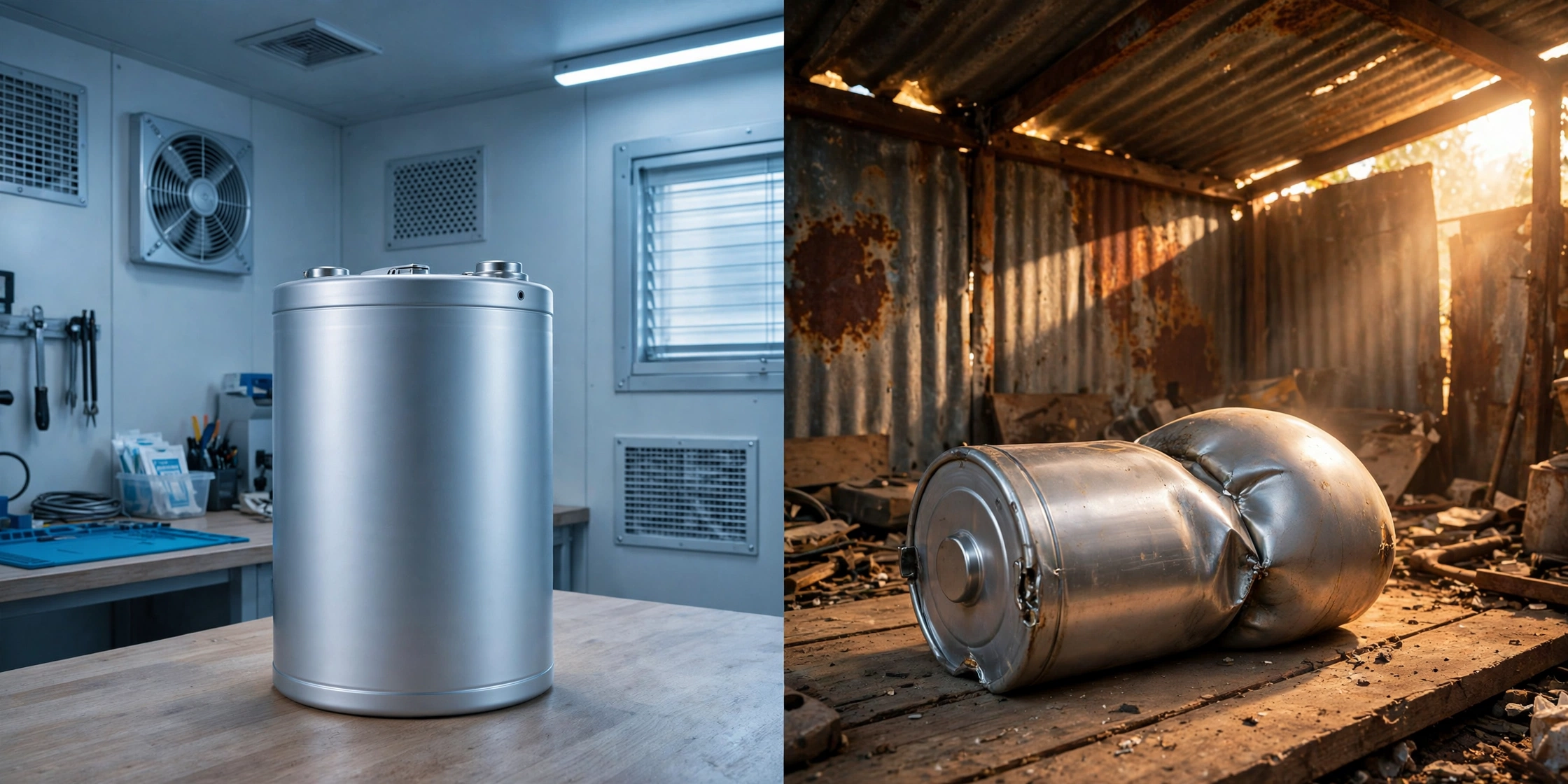
- Swelling or bulging of the battery casing. Stop using the battery immediately and consult a professional — this indicates internal gas formation and is a safety issue. Do not puncture, open, or attempt to repair a swollen lithium battery.
- BMS high-temperature cutoffs on hot afternoons. If your system stops charging during peak sun and resumes in the evening, the battery is telling you its location is too hot.
- Noticeably shorter backup time compared to the cooler months, beyond normal variation.
- Hot casing to the touch during normal (not fast) charging — warm is normal, hot is not.
- For lead-acid: rapid water loss, warped or discolored casing, rotten-egg smell (hydrogen sulfide), white/blue corrosion crusting heavily on terminals.
Safety note: if a lithium battery is swelling, leaking, smoking, or extremely hot, treat it as an emergency: disconnect it if safe to do so, move it away from flammable materials, ventilate the area, and call your supplier or a qualified technician. Never put a damaged lithium battery in household waste.
Buying a Battery for a Hot Climate: What to Check
If you are buying now, heat tolerance should be an explicit selection criterion — not an afterthought.
- Read the charging temperature spec, not just the discharge spec. Prefer batteries rated for charging up to 50–55°C if your installation runs hot. The datasheet’s temperature table (like the one in this article) is the first thing to check.
- Confirm BMS temperature protection. A proper BMS must include over-temperature protection on both charge and discharge, plus cell balancing. Ask the seller specifically — “temperature protection” should be a line item, not an assumption. Cheap packs with weak BMS protection are the most dangerous batteries in hot climates.
- Choose LiFePO4 for stationary storage. Its thermal stability advantage over NMC is worth real money in a 46°C summer. See our 2026 buying guide for what else to evaluate.
- Check the warranty’s fine print. Some warranties exclude operation outside the rated temperature range. A 10-year warranty means little if your 48°C battery room voids it — another reason placement matters.
- Do not oversize blindly, but do not undersize either. An undersized battery runs hotter (higher C-rates generate more internal heat) and cycles deeper. Sizing guidance is in our battery lifespan tips.
Frequently Asked Questions
What is the safe temperature range for lithium batteries?
For LiFePO4: charging 0°C to 45°C (some models up to 50–55°C), discharging -20°C to 60°C, long-term storage -10°C to 35°C, with 15–35°C optimal for lifespan. Always verify against your specific battery’s datasheet, as limits vary by manufacturer.
Do lithium batteries overheat in summer?
They can. While lithium batteries generate less internal heat than many expect during normal solar cycling, sustained ambient temperatures above 40–45°C accelerate chemical degradation, and most BMS units will refuse to charge above ~45–50°C. The risk in Pakistan is not sudden overheating but cumulative heat aging — plus lost charging hours on the hottest afternoons.
Can I keep my solar battery on the rooftop?
Only with a properly shaded, ventilated, and insulated housing — and even then, monitor temperatures. A bare metal box on a Pakistani rooftop in June can exceed 55°C inside, which is beyond the charging limit of most batteries. An indoor shaded room is strongly preferable.
Is LiFePO4 or NMC better for hot climates?
LiFePO4. Its iron-phosphate chemistry is inherently more thermally stable, its cycle life is longer, and it tolerates sustained heat better. NMC packs more energy per kilogram (useful for EVs) but degrades faster in heat — a poor trade for stationary home storage in a hot country.
Does heat affect lead-acid batteries more than lithium?
Yes, significantly. The widely cited industry rule is that lead-acid lifespan halves for every 10°C above 25°C, driven by grid corrosion and water loss. Lithium (especially LiFePO4) degrades with heat too, but far more slowly — one of the strongest practical reasons to switch in hot climates.
Should I reduce charging on extremely hot days?
If your inverter allows it, slightly lowering the charge current during peak afternoon heat reduces internal heating, and capping daily charge at 90% instead of 100% avoids the damaging high-SOC-plus-heat combination. Do not disable charging entirely — a half-charged battery going into a load-shedding evening is worse than a warm one.
What temperature should a battery room be?
Aim for 15–35°C, and treat 45°C as a hard ceiling for the battery’s immediate surroundings during charging. If your battery location regularly exceeds 40°C in summer, add ventilation, shading, or an exhaust fan; if it exceeds 45°C, relocate the battery.
Conclusion
In Pakistan, heat is not an edge case — it is the operating environment. A battery that would last 12 years in a cool climate can die in four inside a sun-baked rooftop box, not because the battery was bad, but because the installation ignored the one number that matters: the charging temperature window.
The good news is that the fixes are cheap and mostly one-time: move the battery to the coolest shaded spot you have, ventilate the space, shade the enclosure, and check on it through the summer. Do that, and you keep most of the 10–15 years your LiFePO4 battery was designed to deliver. Skip it, and every summer quietly collects its tax in lost capacity.
If you are buying a battery now, make temperature specs part of the decision — check the charging window on the datasheet, confirm the BMS includes temperature protection, and choose LiFePO4 for stationary storage. Our 2026 buying guide walks through the rest of the checklist.
Sources & Further Reading
- MDPI Applied Sciences — Study on Influencing Factors of Calendar Aging and Cycle Aging of LFP Batteries
- Beijing Institute of Technology — From Calendar Aging to Cycle Degradation: SOC-Dependent Structural Evolution in LiFePO4/Graphite Batteries (research record; published 1 Apr 2026)
- Savolture — LiFePO4 Battery Operating Temperature: Charge, Discharge & Storage Ranges
- Li Time — 51.2V LiFePO4 Battery Product Manual (example datasheet temperature ranges)
- PoweringAutos — Lead Acid Battery Lifespan (50%-per-10°C rule, via Battery University)
- Pakistan Press Foundation — Heatwave Grips Pakistan (recorded peak temperatures)
Last updated: October 2026. Battery specifications and prices change over time — always verify the datasheet and current pricing before purchasing.