Lithium Battery Cycle Life Explained: What 3,000–6,000 Cycles Really Mean
If you are shopping for a lithium battery for your solar setup or UPS in Pakistan, you have probably seen the numbers shouted from every product listing: 3,000 cycles… 5,000 cycles… 6,000 cycles. Sellers present the number as proof that the battery will last “forever,” but almost nobody explains what the number actually measures — or what it means for your home.
This guide translates battery cycle life into plain language: what a “cycle” really is, why lithium iron phosphate (LiFePO4) batteries advertise such high numbers, how cycle counts turn into real years of service, and what a realistic lifespan looks like for a Pakistani household running solar or backup power.
Quick answer
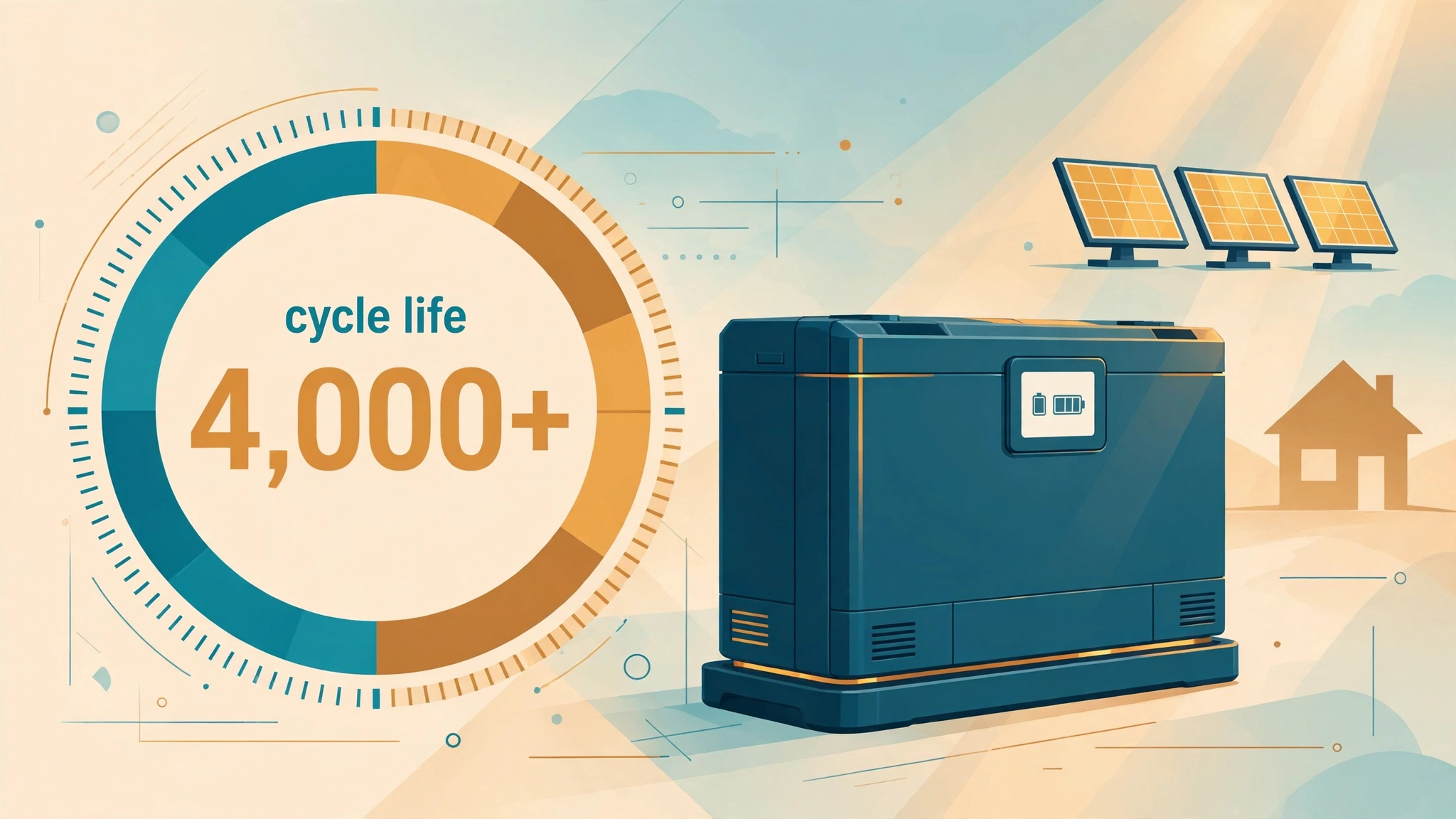
A battery’s cycle life is the number of full charge-and-discharge cycles it can deliver before its capacity fades to about 80% of its original rating. A quality LiFePO4 battery rated for 4,000 cycles will, roughly, serve 8–11 years of daily cycling at moderate depth of discharge — but the real number depends on how deeply you discharge it, how hot it gets, and how you charge it. Partial cycles count proportionally, so using 50% of your battery two days in a row equals one full cycle, not two.
Contents
- What is a battery cycle, exactly?
- What “end of life at 80%” really means
- Why LiFePO4 advertises 3,000–6,000 cycles
- Turning cycles into years: the math
- Depth of discharge: the biggest lever on cycle life
- Calendar aging: the clock that ticks even when you don’t cycle
- What kills cycles early
- LiFePO4 vs NMC vs lead-acid: cycle life comparison
- Realistic expectations for a solar/UPS home setup in Pakistan
- What longer cycle life means for your wallet
- How to actually get the rated cycles
- FAQs
- Conclusion
What is a battery cycle, exactly?
A charge cycle is one complete discharge of 100% of a battery’s rated capacity followed by a full recharge. The key word is cumulative: the cycle does not have to happen in one sitting.
Imagine a 100Ah battery:
- Monday: you use 50Ah (discharge to 50%), then recharge to full.
- Tuesday: you use another 50Ah, then recharge to full.
That is one full cycle, not two. Industry convention counts “full equivalent cycles” — the sum of all partial discharges divided by the battery’s capacity. A delivery rider who drains an e-bike battery to 70% on each of two days has consumed roughly 0.6 of a cycle, not two cycles.
This matters because it changes how fast you burn through the rated cycle count. If your home battery only discharges 40% on a typical night, one calendar day is less than half a cycle — which is why well-sized home batteries often outlast their rated cycle count in years.
Why “cycle life” always comes with test conditions
Manufacturers do not measure cycle life in someone’s living room. A typical lab rating for an LiFePO4 cell is defined by test conditions such as:
- Depth of discharge (DoD): how far the battery is drained each cycle (commonly 80% or 100% for lithium ratings).
- Charge/discharge rate (C-rate): how fast the battery is charged and drained — often 0.5C or 1C (meaning a full charge or discharge in two hours or one hour).
- Temperature: usually around 25°C in a controlled lab.
- End point: the test stops when capacity falls to 80% of the original rating.
When a datasheet says “6,000 cycles,” it means: under these lab conditions, the cell still held at least 80% of its original capacity after 6,000 full equivalent cycles. Different manufacturers test differently, so two products that both claim “6,000 cycles” may have been measured under different DoD, temperature, or C-rate conditions. Always ask for the test conditions behind the headline number — a lower number measured at harsher conditions can be the more honest rating.
What “end of life at 80%” really means
The industry’s standard end-of-life threshold for rechargeable batteries is 80% of original capacity. This surprises most people: “end of life” does not mean the battery is dead.
If your 100Ah LiFePO4 battery has cycled down to its rated 4,000 cycles, it typically still holds around 80Ah. It charges, discharges, and powers your home — it just needs recharging a little sooner, or covers a slightly smaller load. A battery past its rated cycle count is usually still perfectly serviceable; it is just running at reduced capacity.
This is worth keeping in mind when comparing warranties too. Many home-battery warranties guarantee at least 70–80% capacity after a fixed period (for example, 10 years) or a fixed number of cycles, whichever comes first. If you want the full picture of how long lithium batteries last beyond the cycle count, that is the metric to watch.
Why LiFePO4 advertises 3,000–6,000 cycles
Not all lithium batteries are the same. The lithium family includes several chemistries, and the ones you meet most often are:
- LiFePO4 (lithium iron phosphate, or LFP) — the chemistry behind most solar storage batteries and portable power stations sold today.
- NMC (nickel manganese cobalt) — the chemistry in most phones, laptops, and electric cars.
- LCO (lithium cobalt oxide) — older phone/laptop chemistry, around 500–1,000 cycles.
LiFePO4 earns its headline cycle numbers from chemistry. Its iron-phosphate cathode structure is unusually stable: it resists the crystal breakdown that repeated charging and discharging causes in other cathodes. It also tolerates heat better and is far less prone to thermal runaway, which is why it has become the default choice for stationary home storage where size and weight matter less than longevity and safety.
For context on the chemistry itself, our ultimate guide to how lithium batteries work walks through what happens inside the cell on every charge and discharge.
Typical rated cycle lives you will see in the market (all to roughly 80% remaining capacity):
- Lead-acid (flooded/AGM): a few hundred to about 1,000 cycles, heavily dependent on depth of discharge.
- NMC: roughly 1,000–2,000 cycles.
- LiFePO4: 3,000–6,000+ cycles, with some commercial cells advertised even higher.
That is not a marginal gap — it is a 3-to-6-fold difference in usable lifespan for chemistry that is also more forgiving of imperfect use.
Turning cycles into years: the math
Cycles become years with one simple division:
Years of service ≈ rated cycles ÷ full equivalent cycles per day ÷ 365
A few worked examples for a 4,000-cycle LiFePO4 battery:
| Your daily use | Full cycles/day | ≈ Years from cycling |
|---|---|---|
| One full cycle every day | 1.0 | 11 years |
| Two cycles per day (heavy use) | 2.0 | 5.5 years |
| Half a cycle per day (typical home backup) | 0.5 | 22 years* |
| One cycle every 3 days | 0.33 | 33 years* |
*Rows marked with an asterisk show why calendar aging (covered below) matters: a battery rarely reaches 22 or 33 years because time degrades it even when it is not being cycled. For a once-daily cycling battery, expect the real lifespan to land in the 8–15 year band, with calendar aging — not cycle exhaustion — deciding the final outcome.
The takeaway is practical: cycling alone almost never limits a home LiFePO4 battery. If you drain it fully every single day for a decade, you will use up the cycles around the same time the calendar would have retired it anyway. For normal household backup use, the cycles are effectively not the constraint.
Depth of discharge: the biggest lever on cycle life
Depth of discharge (DoD) is the percentage of the battery’s capacity you use before recharging. Use 80Ah from a 100Ah battery and you discharged to 80% DoD. The deeper each discharge, the fewer total cycles the battery delivers — this relationship is the single biggest driver of real-world battery lifespan, and it affects every chemistry.
The effect is dramatically non-linear. Data compiled from published battery comparison tables and manufacturer figures (see Sources) gives an indicative picture:
| Depth of discharge | Lead-acid (typical) | LiFePO4 (typical) |
|---|---|---|
| 100% (full drain) | ~50–100 cycles | ~3,000–4,000 cycles |
| 80% | ~150–250 cycles | ~4,000–5,000 cycles |
| 50% | ~300–500 cycles | ~6,000+ cycles |
| 30% or less | ~800+ cycles | ~10,000+ cycles |
(Cycle counts are indicative ranges drawn from public comparison data; exact figures vary by manufacturer, test conditions, and cell quality.)
Two lessons fall out of this table:
- Lead-acid punishes deep discharge brutally. This is why experienced installers size lead-acid banks so they are rarely drained past 50% — the bank is effectively twice as big as the energy you plan to use.
- LiFePO4 tolerates deep discharge far better, but shallower cycling still buys you noticeably more life. Keeping a daily-use LiFePO4 between roughly 20% and 80% state of charge is the commonly recommended sweet spot for longevity without giving up much usable energy.
Calendar aging: the clock that ticks even when you don’t cycle
Batteries degrade in two ways:
- Cycle aging — wear from charging and discharging.
- Calendar aging — slow chemical degradation over time, even when the battery sits unused.
Calendar aging is driven mainly by temperature and the state of charge at which the battery rests. A battery stored fully charged in a hot rooftop shed ages noticeably faster than one stored half-charged in a cool room. For a home battery that cycles once a day, technical references note that calendar aging often becomes the binding limit after roughly 10–15 years — the battery may never reach its rated cycle count simply because time gets there first.
This also answers a common worry for backup users: a UPS battery that mostly sits at full charge waiting for a power cut is aging by the calendar the whole time. Our article on whether lithium batteries degrade when not in use covers how storage conditions affect this idle aging.
What kills cycles early
The lab rating assumes gentle conditions. These are the real-world cycle killers, roughly in order of impact:
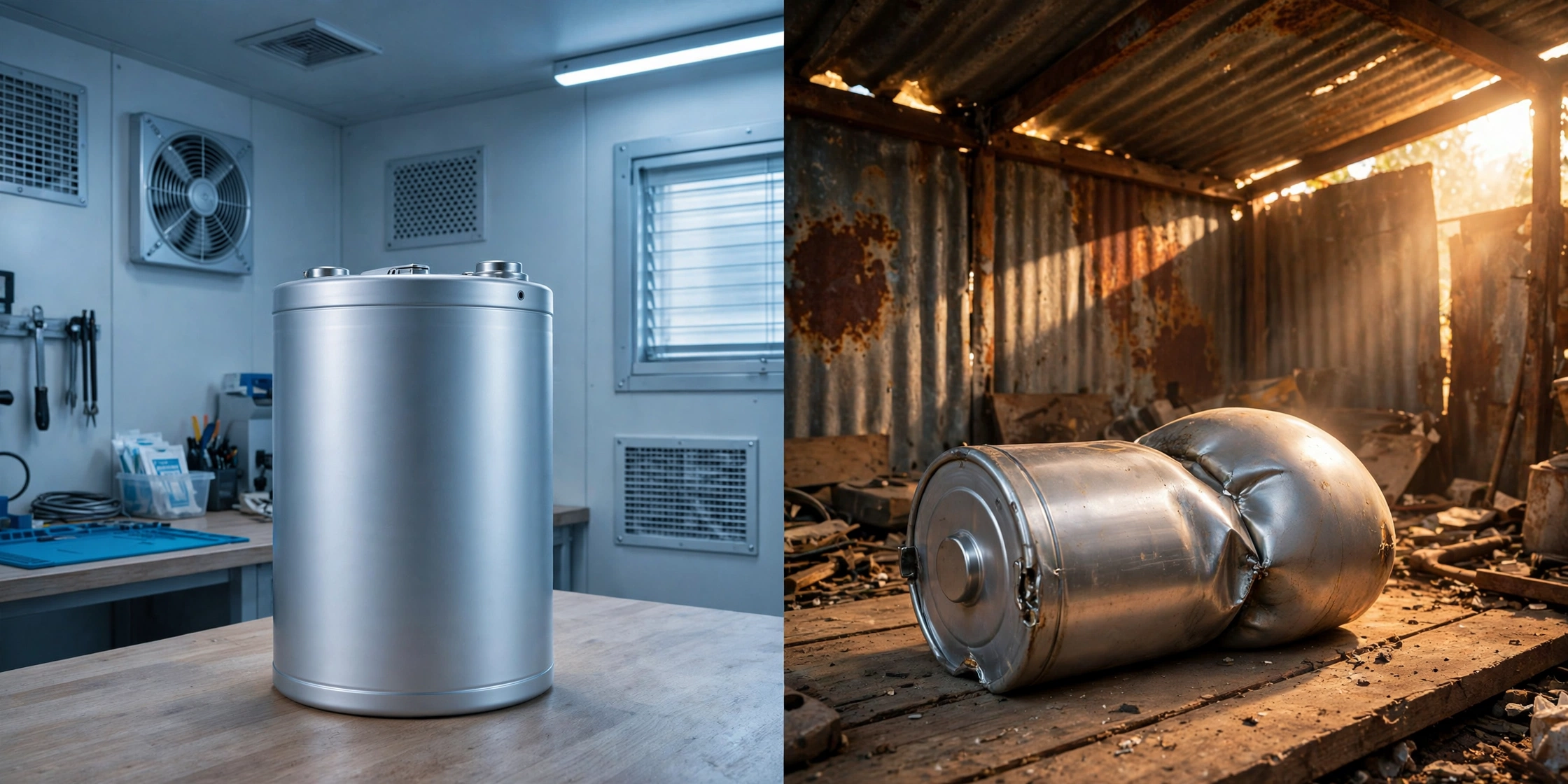
- Heat. High temperatures accelerate chemical degradation in every battery chemistry. In Pakistan’s summers, batteries installed in unventilated rooftop enclosures or sun-baked sheds can sit at 40°C+ for months. Keeping cells near 25°C is ideal; every stretch above that shaves life. See our guide on lithium battery temperature range and hot-climate care.
- Deep discharge (for lead-acid) and 0% storage (for everything). Running a lead-acid bank to empty regularly destroys its cycle life, as the table above shows. For lithium, the risk is different: letting it sit at a very low charge for long periods can cause irreversible damage. The BMS in a quality pack usually prevents the worst of this.
- Overcharging and wrong charger profiles. Charging a lithium battery with a charger meant for lead-acid — especially one with desulfation or equalization modes — can over-volt the cells. Use a charger or inverter with a proper lithium profile.
- Sustained high C-rates. Pulling very high current (fast discharge) or charging at the maximum rate constantly stresses the electrodes. Home solar/UPS duty is usually gentle (well under 0.5C), so this matters more for EVs and power tools than for your inverter.
- Cheap cells and no BMS. A battery management system protects against overcharge, over-discharge, and overheating. Unbranded packs with weak or missing BMS protection routinely die far short of their claimed cycle counts. We covered the full rogues’ gallery in what damages lithium batteries.
LiFePO4 vs NMC vs lead-acid: cycle life comparison
Putting the three chemistries Pakistani buyers actually encounter side by side:
| Feature | Lead-acid (flooded/AGM) | NMC lithium | LiFePO4 (LFP) |
|---|---|---|---|
| Rated cycle life | ~300–1,000 | ~1,000–2,500 | ~3,000–6,000+ |
| Usable depth of discharge | ~50% (for reasonable life) | ~80–90% | ~90–100% |
| Usable energy per “100Ah” | ~50Ah | ~85Ah | ~95Ah |
| Typical service life | 2–5 years | 7–10 years | 10–15 years |
| Upfront cost | Lowest | High | Medium-high |
| Cost per usable cycle | Highest | Medium | Lowest |
| Maintenance | Regular (water, terminals) | None | None |
| Best for | Tight budgets, light standby use | EVs, phones, tight spaces | Home solar, UPS, daily cycling |
(Cycle-life figures are typical published ranges to ~80% remaining capacity; individual products vary.)
The “usable energy” row deserves emphasis: a 100Ah lead-acid battery that should only be discharged to 50% gives you about 50 usable amp-hours, while a 100Ah LiFePO4 at 90%+ DoD gives you nearly double the usable energy from the same nameplate rating. That hidden difference is a big part of why the cycle-life advantage translates into such different economics — more in the next section, and in our detailed lithium vs lead-acid comparison.
Realistic expectations for a solar/UPS home setup in Pakistan
How does all this play out in a typical Pakistani home? Consider the two most common patterns:
Pattern 1: Daily solar cycling. A household with rooftop panels charges the battery during the day and runs evening loads from it. That is roughly one partial cycle per day — typically 40–70% DoD for a sensibly sized bank. A quality LiFePO4 battery in this duty should comfortably deliver 10+ years; the cycles alone would take far longer to exhaust. The realistic threat is summer heat in the battery location, not cycle count.
Pattern 2: UPS backup with load shedding. The battery sits mostly full and only cycles during outages. Cycle consumption is low — perhaps a few dozen to a couple hundred full equivalent cycles per year. Here calendar aging dominates: expect the battery’s age and storage conditions to matter far more than its cycle rating. Keep it ventilated and avoid parking it in a hot, sealed enclosure.
Either way, the honest bottom line for a Pakistani buyer: a good LiFePO4 home battery should be thought of as a 10-to-15-year asset, roughly two to three times the service life of a lead-acid bank doing the same job. Lead-acid in daily cycling duty in a hot climate often needs replacement in 2–3 years — the “cheap” battery gets bought three or four times over the lithium battery’s life.
What longer cycle life means for your wallet
Sticker price is the wrong way to compare batteries. The right question is cost per usable cycle — how much you pay for each full cycle’s worth of energy over the battery’s life.
Work it out in relative units (no real prices needed): suppose a lithium battery costs 3 units upfront and delivers 3,000 cycles at 80% usable depth = 2,400 usable cycle-units, so its cost is 3 ÷ 2,400 ≈ 0.00125 per unit. A lead-acid battery costing 1 unit delivers 500 cycles at 50% usable depth = 250 usable cycle-units, so 1 ÷ 250 = 0.004 per unit. In this illustration, lithium is roughly three times cheaper per unit of usable energy despite the higher upfront price. (This relative-units method is the standard industry illustration; your own numbers will differ.)
In Pakistan’s market, a LiFePO4 pack typically costs roughly two to three times what a comparable lead-acid bank costs upfront, as of October 2026 — but it delivers on the order of six to ten times the usable cycles. When lead-acid also forces you to buy and haul replacement banks every couple of years, the lifetime economics favor lithium for any daily-cycling application. For light, occasional standby use on a tight budget, lead-acid can still be the rational choice.
How to actually get the rated cycles
A short checklist to make your battery live up to its spec sheet:
- Size it generously. Running a bigger bank at 50–60% DoD beats hammering a small bank to 100% every day.
- Keep it cool. Shade, ventilation, and avoiding direct sun on the enclosure matter more than any other single habit in Pakistan.
- Use the right charger profile. Lithium profile for lithium batteries; never a lead-acid equalization cycle on a lithium pack.
- Don’t store it at 100% in the heat. If the battery will sit unused for months, storing around 50–60% charge in a cool spot slows calendar aging.
- Buy from a reputable brand with a real BMS. The spec sheet only means something if the cells and electronics are genuine.
- Check the warranty fine print. A warranty that guarantees a minimum capacity after a set number of years is worth more than a big cycle number with no test conditions attached.
FAQs
What is one battery cycle in simple terms?
One cycle is a full discharge and recharge of 100% of the battery’s rated capacity — but it does not have to happen at once. Using 50% today and 50% tomorrow counts as one full cycle. Partial uses add up proportionally.
Do partial charges and discharges count as full cycles?
No — they count proportionally as fractions of a cycle. This is good news: shallow daily use accumulates cycles slowly, which is one reason home batteries last many years.
What does “6,000 cycles” on a product listing actually promise?
It promises that under the manufacturer’s lab test conditions (a stated depth of discharge, charge rate, and temperature), the battery still held at least 80% of its original capacity after 6,000 full equivalent cycles. Always ask for the test conditions — the number alone is not comparable across brands.
Does a battery die when it reaches its rated cycle count?
No. The 80%-capacity threshold is the industry’s standard end-of-life definition, not a death certificate. A battery at 80% capacity still works; it simply stores a bit less energy than when new and may need replacing sooner for demanding applications.
How many years is 4,000 cycles?
Divide by your daily full-equivalent cycles. One full cycle per day ≈ 11 years; half a cycle per day ≈ 22 years from cycling alone — though calendar aging usually retires the battery before cycling does, so a realistic home-battery expectation is 10–15 years.
Why does LiFePO4 have so many more cycles than other lithium batteries?
Its iron-phosphate cathode is chemically very stable under repeated charging and discharging, it tolerates heat better, and it is less prone to thermal runaway. That stability is also why LiFePO4 dominates home solar storage, while NMC (fewer cycles, higher energy density) dominates phones and EVs.
How can I make my battery reach its rated cycle life?
Keep it cool and ventilated, avoid draining it to empty daily, use a charger with the correct lithium profile, buy a pack with a proper battery management system, and size the bank so normal use stays in the 20–80% charge band.
Conclusion
Battery cycle life is simpler than the spec sheets make it look: it is the count of full charge-discharge cycles a battery delivers before fading to about 80% of its original capacity. LiFePO4’s 3,000–6,000-cycle ratings reflect genuinely stable chemistry — three to six times the cycling endurance of lead-acid and roughly double or more that of NMC.
For a Pakistani home, three ideas are worth carrying away. First, partial cycles count proportionally, so normal household use burns through cycles far slower than the headline numbers suggest. Second, depth of discharge is the lever that matters most — and it is where lead-acid fails hardest. Third, in real homes heat and calendar aging decide a battery’s fate more often than cycle exhaustion does, so installation location and ventilation deserve as much attention as the brand name.
Buy enough capacity to stay shallow, keep the battery cool, charge it correctly — and a quality LiFePO4 bank should quietly do its job for a decade or more, while the “cheap” alternative gets replaced two or three times over.
Sources & Further Reading
- Wikipedia — Comparison of commercial battery types: cycle durability of lead-acid, lithium iron phosphate, and other chemistries at varying depths of discharge.
- Aferiy UK — Lead Acid Battery vs LiFePO4 vs Lithium NMC: DoD-vs-cycle-life table and three-chemistry comparison (3,000–6,000 cycles for LiFePO4).
- LiTrue Battery — Lithium Ion Battery Versus Lead Acid: Which Is Better for Your Application?: real LFP cell specs (≥3,000 cycles at 1C/1C), usable capacity, and a cost-per-cycle illustration in relative units.
- PretaPower — What Affects the Cycle Life of LiFePO4 Solar Batteries?: factors influencing cycle life (DoD, charging, temperature, cell quality) and real-life runtime calculations.
- Bonnen Batteries — How to extend the service life of lithium batteries: calendar aging vs cycle aging, DoD, charge rate, and temperature effects.