12V vs 24V vs 48V Lithium Batteries: Which Voltage Do You Need?
Quick answer: For most Pakistani homes running a real solar setup, 48V (51.2V LiFePO4) is the right answer. It keeps current low, cables thin, and efficiency high — and nearly every 5kW–8kW hybrid inverter sold in Pakistan is built for it. Choose 12V only for tiny backup and lighting setups under 1kW, and 24V for small 1–3kW residential systems. The battery voltage must always match your inverter’s battery input voltage — get that wrong and the system simply won’t work.
Table of Contents
- What Does Battery Voltage Actually Mean?
- 12V Lithium Batteries: Small Backup and Lighting
- 24V Lithium Batteries: The Middle Ground
- 48V (51.2V) Lithium Batteries: The Home Solar Standard
- Side-by-Side Comparison Table
- Why Higher Voltage Means Lower Current (With Worked Examples)
- Current and Wire Size Table for a 3kW Inverter
- Voltage Must Match Your Inverter
- Series vs Parallel Wiring: The Basics and the Warnings
- Rough Pricing in Pakistan (as of October 2026)
- How to Choose: A Simple Decision Guide for Pakistan
- Common Mistakes to Avoid
- Frequently Asked Questions
- Conclusion
- Sources & Further Reading
What Does Battery Voltage Actually Mean?
System voltage is the nominal DC voltage of your battery bank — the voltage at which energy is stored, managed by the charge controller, and delivered to the inverter. Every component in the system (panels, charge controller, batteries, inverter, wiring, fuses) must be built around this one number.
The reason voltage matters so much comes down to a single equation:
Power (watts) = Voltage (volts) × Current (amps)
A 3,000W load on a 48V system draws only about 62.5 amps. The same 3,000W on a 12V system draws 250 amps — four times the current. And because resistive power loss in a cable grows with the square of current, that 12V setup wastes roughly sixteen times more energy as heat in the same cable. Lower current means thinner wires, cheaper cabling, smaller fuses, less voltage drop over distance, and a system that runs cooler and more efficiently.
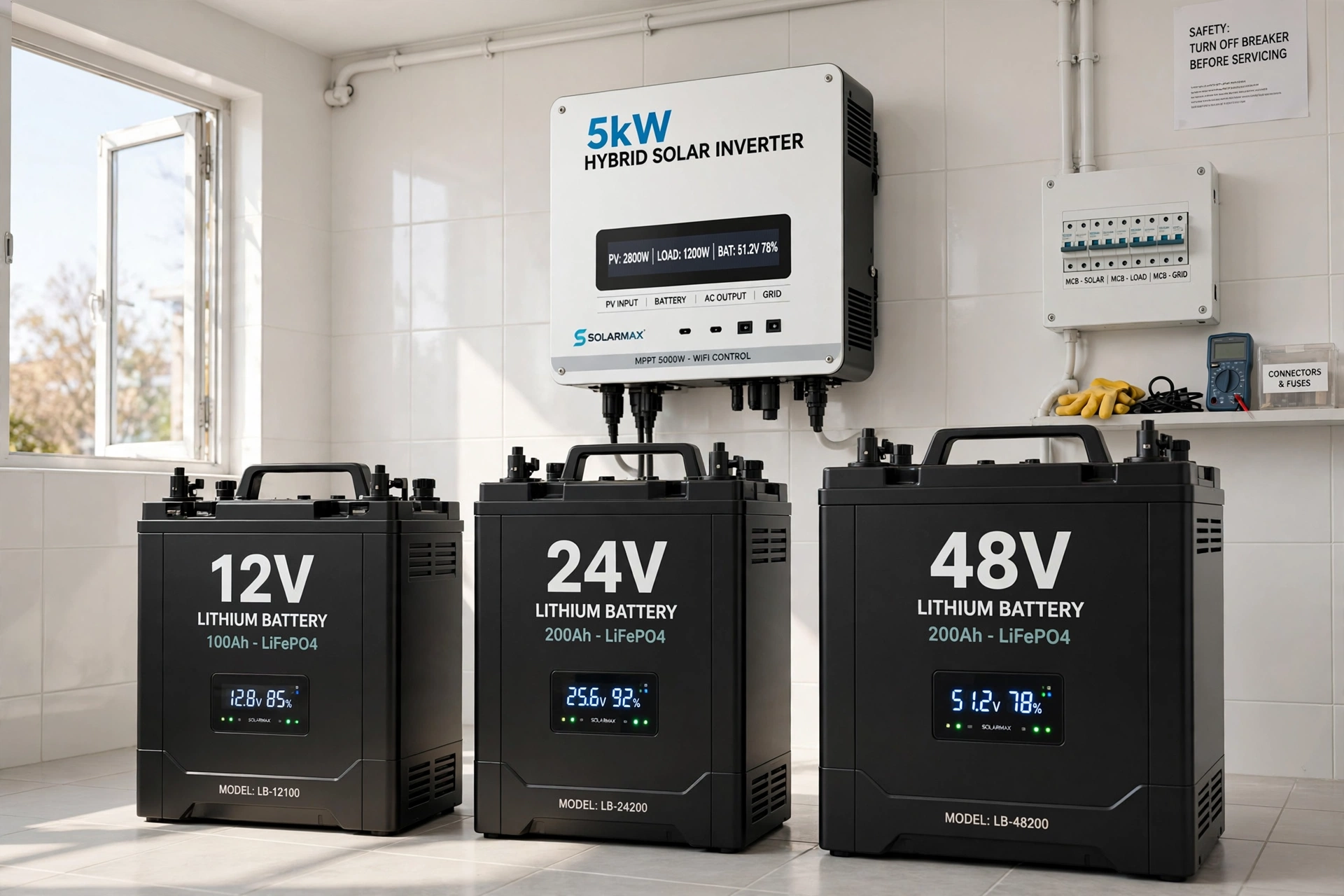
For lithium specifically, one more piece of background helps. Most home solar lithium batteries use LiFePO4 chemistry, built from 3.2V cells wired in series. That is why the “12V / 24V / 48V” labels are really 12.8V (4 cells), 25.6V (8 cells), and 51.2V (16 cells) in practice. When you see “51.2V” on a wall-mounted battery, that is the battery maker’s way of saying “48V class” — it connects to 48V inverters and charge controllers normally. For an introduction to how these batteries store and release energy, see our guide on how lithium batteries work.
12V Lithium Batteries: Small Backup and Lighting
A 12V lithium battery (nominally 12.8V in LiFePO4) is the entry point. It is the simplest to understand, the easiest to install, and it enjoys the widest compatibility with DC accessories — 12V LED lights, DC fans, phone chargers, water pumps, and small 12V inverters.
12V is the right choice when:
- Your total load stays under about 1,000W — a couple of rooms with LED lights, fans, and phone charging.
- You are backing up a small UPS-style inverter (500W–1,500W) for load shedding.
- You want a portable or camping setup: a small panel, one battery, one charge controller, done.
- You run mostly 12V DC loads directly, avoiding inverter losses entirely.
Where 12V falls short: the current problem arrives early. A 2,000W inverter on a 12V bank pulls roughly 185 amps once inverter efficiency is factored in, which demands very thick copper cable and large fuses — expensive and harder to work with. Most 12V inverters top out around 3,000W, and beyond that the cable sizes become impractical. Growing a 12V system into a full-home setup usually means replacing everything.
To add capacity at 12V, you wire extra 12V batteries in parallel (positive to positive, negative to negative) — capacity in amp-hours goes up while voltage stays at 12V. More on that in the wiring section below.
24V Lithium Batteries: The Middle Ground
Stepping up to 24V (nominally 25.6V in LiFePO4) halves the current for the same power compared with 12V. It handles 1,000W–3,000W loads comfortably and is a strong fit for small homes, shops, or tube-well-lite setups: a fridge, lights, fans, a laptop, a water pump, and occasional power tools.
24V is the right choice when:
- Your inverter is in the 2kW–3kW range.
- You want meaningfully better efficiency and thinner cabling than 12V, without committing to a large home system.
- Your installer recommended a mid-size hybrid inverter with a 24V battery input.
Trade-offs to know: 24V sits in an awkward middle for DC accessories — most DC gadgets are built for 12V, so running them off a 24V bank needs a 24V-to-12V DC-DC converter. Component selection is adequate but not as broad as the 12V or 48V worlds. In Pakistan’s market, 24V lithium batteries are available but noticeably less common than 12V drop-in units or the 48V wall-mount stacks, which can make replacement and expansion a little slower.
You can build 24V two ways: buy a native 24V battery, or wire two identical 12V batteries in series (positive of the first to negative of the second). For more capacity, you wire matched 24V strings in parallel.
48V (51.2V) Lithium Batteries: The Home Solar Standard
A 48V-class lithium battery (sold as 51.2V in LiFePO4) is the professional standard for serious home solar in Pakistan. It is what most installers quote for systems above 3kW, and it pairs with the 5kW–8kW hybrid inverters — the workhorses of the Pakistani market — that run fans, fridges, washing machines, water motors, and inverter air conditioners.
48V is the right choice when:
- Your inverter is 3kW or larger — this is the single clearest signal.
- You want the most efficient, easiest-to-expand system with the thinnest cabling.
- You are planning a whole-home setup or future expansion (adding panels or batteries later).
- The battery bank sits some distance from the inverter, where voltage drop matters most.
The modern 48V market is deep: wall-mount and server-rack style LiFePO4 units with built-in smart BMS are widely available in Pakistan, typically in 5kWh, 10kWh, and 15kWh stacks that communicate with compatible hybrid inverters. You can start with one 5kWh unit and add a second in parallel later — expanding capacity without rewiring your voltage architecture. When picking a brand, our roundup of lithium battery brands available in Pakistan can help you compare what’s on the shelf.
The one real downside: higher upfront cost per battery, and 48V inverters and components are overkill for tiny loads — a 5kW hybrid inverter for a two-room backup is wasted money and wasted space.
Side-by-Side Comparison Table
| Feature | 12V | 24V | 48V / 51.2V |
|---|---|---|---|
| Nominal LiFePO4 voltage | 12.8V | 25.6V | 51.2V |
| Typical system size | Under 1kW | 1–3kW | 3kW and up |
| Typical inverter | Under 1,500W | 2–3kW | 5kW–15kW |
| Current for the same power | Highest (4×) | Medium (2×) | Lowest (1×) |
| Cable size needed | Thickest, most expensive | Moderate | Thinnest, cheapest |
| Efficiency / heat losses | Lowest | Medium | Highest |
| Best for in Pakistan | Single-room backup, DC lighting, portable kits | Small home, shop, 2–3kW hybrid inverter | Full home solar, 5–8kW hybrid inverter |
| Expansion headroom | Low — usually a dead end | Medium | High — add batteries in parallel |
| DC accessory compatibility | Excellent (native 12V) | Needs DC-DC converter for 12V gadgets | Needs inverter or converter |
| Upfront cost | Lowest per battery | Mid | Highest per battery |
Why Higher Voltage Means Lower Current (With Worked Examples)
Let’s make the math concrete, because this is the entire reason the industry standardizes on 48V for home systems. Using P = V × I (current = power ÷ voltage):
Example 1: Running a 3kW load
- At 12V: 3,000 ÷ 12 = 250 amps
- At 24V: 3,000 ÷ 24 = 125 amps
- At 48V: 3,000 ÷ 48 = 62.5 amps
The 12V system must push four times the current of the 48V system through its cables. Real-world cables have resistance, so voltage drop and heat losses climb steeply as current climbs — loss scales with current squared.
Example 2: A 5kW inverter (common in Pakistani homes) at full load
- At 24V: 5,000 ÷ 24 ≈ 208 amps — a serious DC current that needs very heavy cabling.
- At 48V: 5,000 ÷ 48 ≈ 104 amps — still substantial, but manageable with standard heavy-gauge battery cable and a sensibly sized fuse.
This is why you almost never see a 5kW inverter with a 24V battery input on the market, and why trying to run a 3kW+ inverter on 12V leads to cable costs that eat the savings of the cheaper battery. As a rule of thumb from off-grid designers: use 12V under 1kW, 24V for 1–3kW, and 48V for anything above 3kW — and if your needs straddle two tiers, choose the higher voltage, since a higher-voltage system can run light loads gracefully but a low-voltage system struggles past its limits.
There is also a charge-controller angle worth knowing: for a given controller amperage rating, a 48V battery bank can accept roughly four times the solar wattage of a 12V bank, because the controller’s limit is current, not watts. That matters when you later add more panels.
Current and Wire Size Table for a 3kW Inverter
The table below shows the battery-side current and indicative cable requirements for a 3,000W inverter at 90% efficiency over a short 10-foot one-way cable run. These figures come from off-grid wiring references (see Sources); always have an electrician size your actual run, since length, temperature, and installation method change the answer.
| System voltage | Battery-side current (3,000W ÷ V ÷ 0.9) | Indicative copper wire size | Relative cable cost |
|---|---|---|---|
| 12V | ~278A | Beyond a single standard conductor — parallel heavy runs or professional design | Highest ($$$) |
| 24V | ~139A | 4/0 AWG (very heavy) | Medium ($$) |
| 48V | ~69A | 2 AWG (heavy but standard) | Lowest ($) |
The takeaway is blunt: at 12V, a 3kW inverter is already past the point where a single cable can safely feed it. At 48V, an ordinary heavy-gauge pair handles the same power. Across a full installation with several cable runs, that difference is real money — plus easier installation and less heat at every connection point.
Voltage Must Match Your Inverter
This is the non-negotiable rule of the whole topic: the battery bank voltage must match the inverter’s battery input voltage. A 48V battery bank will not run a 24V inverter, and a 12V inverter cannot be connected to a 48V bank. The same applies to the solar charge controller, fuses, breakers, busbars, and the battery monitor — every major component is specified for one voltage.
In practice, this means you should usually pick the inverter first, then buy the battery to match it — not the other way around. In Pakistan, most 5kW–8kW hybrid inverters (the ones quoted for typical homes) specify a 48V battery input, which is why the 48V decision so often makes itself. If you already own a 12V or 24V inverter, your battery voltage is decided for you.
Also check the BMS rating of the battery you buy: the battery’s internal Battery Management System must be rated for the current your inverter will draw. A 5kW inverter at 48V can pull over 100A, so a battery with a 50A BMS will shut down (or worse) under full load — look for 100A BMS or higher on 5kWh-class units paired with big inverters.
Series vs Parallel Wiring: The Basics and the Warnings
If you don’t buy a native 48V battery, you may build your voltage from smaller units. Two wiring patterns do all the work:
Series wiring (voltage adds up, capacity stays the same). Connect the positive terminal of one battery to the negative of the next. Two 12V 100Ah batteries in series give you 24V 100Ah; four in series give you 48V 100Ah. Series is how you raise the voltage to match your inverter.
Parallel wiring (capacity adds up, voltage stays the same). Connect positives to positives and negatives to negatives. Two 12V 100Ah batteries in parallel give you 12V 200Ah. Parallel is how you add backup hours at the same voltage.
Series-parallel combines both: build matched series strings first, then parallel those strings for more capacity.
Safety warnings — read these before touching a wrench:
- Use identical batteries only. Same brand, same model, same capacity (Ah), same chemistry, same BMS rating, and ideally the same age and purchase batch. Mixing different batteries in series is unsafe and unreliable — the weakest unit hits its limits first, triggers early BMS shutdowns, and can create dangerous imbalances. Most manufacturers explicitly void the warranty on mixed banks.
- Check the manufacturer’s series/parallel limits. Many lithium batteries are rated for a maximum number in series (e.g., 4 in series, 4 in parallel). Exceeding it can bypass the BMS’s protections.
- Charge parallel batteries to the same voltage before connecting. Connecting two batteries at very different charge levels can send a large inrush current between them. Bring them to equal voltage first.
- Fuse every string. Each parallel string should have its own appropriately rated fuse or breaker on the positive conductor, sized just above the string’s expected maximum current, mounted close to the battery.
- Never mix chemistries (LiFePO4 with lead-acid, for example) in one bank.
- Torque and inspect. Loose or corroded connections become hot spots, especially at the high currents of 12V and 24V systems. Use insulated tools and covered busbars, and never work on a live bank.
If any of this feels beyond your comfort zone, have a qualified installer do the wiring — high-current DC mistakes are expensive in a way that AC mistakes rarely are.
Rough Pricing in Pakistan (as of October 2026)
Prices move with the dollar rate, import duties, and brand, so treat these as rough market ranges as of October 2026, not quotes. The underlying pattern is stable though: per unit of stored energy, cost is broadly comparable across voltages — you pay more for a 48V battery because it contains far more energy.
Based on current Pakistani market listings (June–October 2026, sourced in our deliverables):
| Configuration | Approx. energy | Rough market range (PKR) |
|---|---|---|
| 12V 100Ah LiFePO4 (generic) | ~1.28 kWh | 85,000 – 110,000 |
| 24V 100Ah LiFePO4 (generic) | ~2.56 kWh | 165,000 – 195,000 |
| 48V 100Ah / 51.2V 100Ah LiFePO4 (generic) | ~5 kWh | 225,000 – 275,000 |
| 51.2V 100Ah branded (e.g., Inverex INV-LV5) | ~5.1 kWh | ~295,000 |
| 51.2V 200Ah wall-mount branded (e.g., Knox 10.2 kWh) | ~10 kWh | ~525,000 |
| 48V-class 300Ah stackable (e.g., Apex 15.36 kWh) | ~15 kWh | ~695,000 |
Cost per kilowatt-hour typically lands between roughly PKR 28,000 and PKR 55,000, with value brands at the lower end and premium inverter-integrated brands at the top. Note that the battery is only part of the system cost: a 48V setup also needs a 48V inverter, which costs more than a small 12V inverter — but for a real home system, the 48V inverter is the one you’d buy anyway. When comparing quotes, focus on PKR per kWh and warranty terms rather than the sticker price alone.
How to Choose: A Simple Decision Guide for Pakistan
Walk through these in order:
- Start with your inverter. If you already own one, your voltage is decided. If you’re buying, match the inverter to your loads: under 1.5kW → 12V class; 2–3kW → 24V class; 5kW and up → 48V class. Our solar battery selection guide walks through matching batteries to real system sizes.
- Estimate your peak load, not just daily energy. Voltage is decided by power (watts), not energy (kWh). A fridge, a few fans, and lights might peak under 1kW (12V or 24V territory); add a water motor, washing machine, and inverter AC and you sail past 3kW into 48V territory. (Capacity sizing — how many kWh of backup you need — is a separate question; see our battery sizing guide once it’s published, and keep voltage and capacity decisions apart.)
- Plan for growth. If you might add an AC or a second floor later, choosing 48V now is far cheaper than replacing a 12V or 24V system later.
- Check what’s actually on the shelf. In Pakistan, 48V wall-mount LiFePO4 units and 12V drop-in batteries are the easiest to source; 24V sits between them.
- Budget the full system, not the battery. A 48V battery costs more, but it needs thinner cables and a smaller charge controller for the same power — and the inverter you’d pair it with is the one your home actually needs.
Common Mistakes to Avoid
- Buying the battery before the inverter. The inverter’s battery input voltage dictates everything. Battery first, inverter second is the most common ordering mistake.
- Running a 3kW+ inverter on 12V. The current becomes absurd, the cables cost a fortune, and the system underperforms.
- Mixing batteries in series. Different brands, ages, or capacities in one series string is asking for imbalance, early shutdowns, and voided warranties.
- Ignoring the BMS current rating. The battery’s kWh number means nothing if its BMS trips at half your inverter’s draw. Size the BMS to the peak load.
- Confusing 51.2V and 48V. They’re the same class — 51.2V is just the more accurate nominal figure for 16 LiFePO4 cells. A “51.2V” battery belongs on a “48V” inverter.
- Thinking higher voltage is always better. A 48V system for a two-room backup is over-engineering — more cost, no benefit. Right-size the voltage.
- Skipping fuses on parallel strings. DC faults don’t self-extinguish the way AC arcs do. Fuse every string, close to the battery.
- Running 12V DC appliances directly off 24V or 48V. You’ll destroy them. Use a properly sized DC-DC converter to step down.
Frequently Asked Questions
1. Is 48V always better than 12V or 24V?
No. 48V is better for larger systems because it carries more power at lower current, but it’s unnecessary for small loads. For a single room or a portable kit, 12V is simpler and cheaper overall. The right voltage depends on your inverter size and total power demand — not on which number looks more impressive.
2. Can I run 12V appliances on a 24V or 48V system?
Yes, but only through a properly sized DC-DC converter that steps the voltage down to 12V. Never connect a 12V appliance directly to a 24V or 48V battery bank — it will be damaged or destroyed.
3. Can I connect 12V lithium batteries in series to make 24V or 48V?
Yes, provided the batteries are identical (same brand, model, capacity, age, and charge level) and the manufacturer allows series connection up to that count. Two identical 12V batteries make 24V; four make 48V. Always follow the manufacturer’s series/parallel limits.
4. What voltage do I need for a 5kW solar inverter in Pakistan?
Effectively always 48V. Almost all 5kW hybrid inverters sold in Pakistan specify a 48V battery input, and running 5kW at lower voltages would demand impractically high current. Pair them with a 48V-class (51.2V) LiFePO4 battery whose BMS is rated for 100A or more.
5. Is 51.2V the same as 48V?
For buying purposes, yes. 51.2V is the more accurate nominal voltage of 16 LiFePO4 cells in series (16 × 3.2V), while “48V” is the traditional system class label. A battery labeled 51.2V connects to 48V inverters and charge controllers normally.
6. How many batteries do I need in parallel for more backup time?
As many identical strings as your manufacturer allows, fused individually. Remember: parallel adds capacity (backup hours), not voltage. If your question is really “how many kWh of storage do I need,” that’s a capacity-sizing question — keep it separate from the voltage decision covered here.
7. Does higher battery voltage make the battery last longer?
Not directly. Battery lifespan is governed by charge cycles, temperature, depth of discharge, and charge quality — our guide on how long lithium batteries last covers this in depth. Higher voltage helps indirectly: lower current means less heat in cables and connections, and a well-matched 48V system stresses its components less at high power.
8. Can I mix old and new batteries, or different brands, in one bank?
Avoid it. Batteries of different age, capacity, or brand charge and discharge unevenly, which causes imbalance, reduces usable capacity, triggers BMS shutdowns, and usually voids the warranty. In series this is outright dangerous; in parallel it’s still poor practice. Buy matched units together.
Conclusion
Battery voltage is one of the first decisions in any solar build, and the rule of thumb is simple: 12V for loads under 1kW, 24V for 1–3kW, and 48V (51.2V LiFePO4) for anything above 3kW. For the typical Pakistani home running a 5kW–8kW hybrid inverter with fans, fridges, motors, and possibly an air conditioner, 48V isn’t just the best choice — it’s practically the only sensible one, giving you lower current, thinner cables, less heat, and easy expansion. Let your inverter’s battery input voltage make the final call, wire identical batteries only, fuse every string, and you’ll have a battery bank that serves your system instead of fighting it. If you’d like the bigger picture first, start with our lithium vs lead-acid comparison before committing to any chemistry.
Sources & Further Reading
- Off Grid Authority — “12V vs 24V vs 48V Solar: Which Voltage Is Right?” (wire sizing table, current math, voltage selection tiers) — https://offgridauthority.com/12v-vs-24v-vs-48v-solar-system/
- BasenGreen — “12V vs 24V vs 48V Battery: Which One Is Best for Solar?” — https://www.basengreen.com/12v-vs-24v-vs-48v-battery-which-one-is-best-for-solar/
- Vatrer — “12V, 24V, or 48V Solar Battery System: How to Choose the Right Voltage” (wire sizing table, current math, voltage selection tiers) — https://www.vatrerpower.com/en-de/blogs/news/12v-vs-24v-vs-48v-which-is-best-for-your-solar-system
- Footprint Hero — “LiFePO4 Battery Voltage Charts (12V, 24V & 48V)” (nominal voltages, charging parameters) — https://footprinthero.com/lifepo4-battery-voltage-charts
- CNC Electric (Pakistan) — “Lithium Battery Pakistan 2026 — LiFePO4 48V” buyer guide (PKR pricing data, June 2026) — https://www.cncelectric.pk/blogs/guides/lithium-battery-price-in-pakistan-2026-lifepo4-48v-buyer-guide-with-dc-protection
- Redodo Power — “Batteries in Series vs Parallel: Which is Better” — https://www.redodopower.com/blogs/learn-about-lithium/batteries-in-series-vs-parallel-which-is-better
- BSLBATT — “How To Wire Batteries In Series Vs Parallel” — https://bslbatt.com/blogs/how-to-wire-batteries-series-vs-parallel/