How to Choose the Right Lithium Battery Size for Your Solar System
What size lithium battery for solar system is enough for your home? This guide walks you through auditing your load, converting daily kWh into battery capacity, matching battery voltage to your inverter, and choosing capacity bands for 1kW, 3kW, 5kW and 10kW Pakistani homes — with rough PKR price ranges as of October 2026.
The Short Answer
Battery size is decided by one number: your home’s daily energy use in kilowatt-hours (kWh). Add up everything you want the battery to run (lights, fans, fridge, AC, pump), divide by the usable share of the battery (about 80% depth of discharge for LiFePO4), and add a margin for inverter and conversion losses. The practical formula is:
Required battery capacity (kWh) ≈ Daily energy use (kWh) × 1.5
So a home that needs 6 kWh of stored energy per day should shop for roughly a 9 kWh battery bank — in practice, two 51.2V 100Ah wall-mount modules (10.24 kWh), which Pakistani retailers currently sell for roughly Rs 190,000–265,000 per module as of October 2026, covering the daily need with a realistic margin.
The rest of this guide shows you how to arrive at your number — not your neighbour’s — so you neither under-buy (dead battery at 2 a.m.) nor over-buy (money sitting idle on the wall).
Why Battery Sizing Is the One Decision You Can’t Fix Cheaply
Every other component in a solar system is easy to swap later. Panels can be added. A charger can be upgraded. But the battery is the most expensive single item, and getting its size wrong hurts in both directions:
- Too small is the classic Pakistani complaint: the battery hits empty during a long load-shedding spell, the inverter shuts off, and the household concludes “solar doesn’t work.” More often, the system works fine — the battery was just undersized for the backup hours the family expected. Our guide on why a battery drains faster than expected covers how load estimation errors play out in real homes.
- Too big is quieter but equally wasteful. A battery that is routinely only 30% discharged still ages by the calendar, and the extra capacity you paid for earns nothing. Batteries are storage, not investments — buying double what you need “for safety” is like building two bedrooms you never enter.
The right size is the one that covers your realistic worst day with about a 20–25% margin — no more.
Step 1: Audit Your Home’s Load (Watts × Hours)
Before you talk to any dealer, make a list. This is the single most important step, and it takes twenty minutes with a notebook. For each appliance you want backed up, note its power in watts and how many hours it runs in the hours the battery must cover.
The table below uses wattages typical of Pakistani homes — ceiling fans, room ACs, water pumps and LED lights. Your actual appliances may differ, so check the label on the back of each device where you can.
| Appliance | Typical power | Hours/day on backup | Energy/day (Wh) |
|---|---|---|---|
| 8 LED bulbs | 12 W total × 8 | 5 h | 480 Wh |
| 4 ceiling fans | 75 W each | 8 h | 2,400 Wh |
| Refrigerator (inverter-type) | 150 W average cycling | 10 h | 1,500 Wh |
| 1.5-ton inverter AC | 1,200 W (running) | 4 h | 4,800 Wh |
| Water pump (1 HP) | 750 W | 0.5 h | 375 Wh |
| LED TV + set-top box | 100 W | 4 h | 400 Wh |
| Washing machine (cold wash) | 400 W | 1 h | 400 Wh |
| Phone/laptop charging | 60 W | 3 h | 180 Wh |
Three things about this table matter more than the numbers themselves:
- The AC dominates everything. One inverter AC for four hours (4.8 kWh) uses more energy than the rest of the home combined. Decide honestly whether the battery needs to run the AC — this single choice usually doubles or triples the required battery size.
- Fridges cycle. A fridge labelled 150 W doesn’t draw 150 W continuously; its compressor cycles on and off. Roughly a third to half of the rated power averaged over the day is a reasonable planning figure.
- Surge current is separate from energy. A water pump or AC compressor draws several times its rated power for a few seconds at startup — typically 3–5 times the rated wattage for a 1.5-ton AC compressor, per industry sizing practice. This doesn’t change the battery size, but it must be within the battery’s maximum discharge current. We’ll come back to this in the mistakes section.
Add up the appliances you actually want on backup and get your daily energy number in kWh. A modest family home without AC typically lands around 3–4 kWh per day; add one AC and you’re at 8–10 kWh.
Step 2: Convert Daily kWh into Battery Capacity
Now apply three adjustments to your daily energy number: depth of discharge, efficiency losses, and a safety margin.
Depth of discharge (DoD)
DoD is the share of the battery’s rated capacity you can use on each cycle. LiFePO4 (lithium iron phosphate) — the chemistry behind nearly every solar lithium battery sold in Pakistan today — can be regularly discharged to about 80–90% without meaningful damage. This is a major reason lithium replaced lead-acid for solar, where the safe limit is roughly 50% (our lithium vs lead-acid comparison explains the full difference).
For sizing math, use 80% DoD as your planning figure. It’s conservative, it matches the cycle-life ratings most manufacturers publish (typically 6,000+ cycles at 80% DoD), and keeping some reserve also protects you on unusually heavy days. If you want a refresher on what those cycle numbers actually mean in years, see our guide on what battery cycles actually mean.
Round-trip efficiency and inverter losses
No conversion is perfect. A quality lithium battery returns roughly 95% of the energy you put into it (round-trip efficiency ≥95%, as published in datasheets such as BYD’s Battery-Box LV5.0+), and a typical hybrid inverter runs at about 90% efficiency when converting battery DC to the AC your appliances use. Multiply the two and about 85% of the battery’s stored energy reaches your appliances. Engineering sizing guides recommend dividing your daily energy figure by the inverter’s efficiency to get the true battery-side requirement.
The formula
Required battery capacity (kWh) = Daily energy (kWh) ÷ DoD (0.80) ÷ system efficiency (~0.85)
Or, simplified for everyday use: multiply your daily energy by about 1.5.
Worked example — a 3kW family home. You want backup for 8 LEDs, 4 fans, the fridge, the TV, the water pump and phone charging — no AC. Daily energy ≈ 4.7 kWh.
- 4.7 kWh ÷ 0.80 ÷ 0.85 ≈ 6.9 kWh of battery
- That’s between one 51.2V 100Ah (5.12 kWh) and two of them (10.24 kWh). One module would be slightly tight for the worst days; two give comfortable headroom for cloudy spells and future loads.
Worked example — a 5kW home with one AC. Add a 1.5-ton inverter AC for 4 hours (≈ 4.8 kWh) and daily energy rises to ≈ 9.5 kWh.
- 9.5 kWh ÷ 0.80 ÷ 0.85 ≈ 14 kWh of battery
- That’s roughly three 51.2V 100Ah modules (15.36 kWh). This is why AC backup is expensive: the AC alone forces you from one module to three.
Step 3: Decide What the Battery Is Actually For
The same home needs a very different battery depending on its job. Pakistani buyers generally want one of three things, and confusing them is the root of most sizing regrets:
- Load-shedding backup. The grid exists; the battery covers scheduled outages. Typical requirement: 4–6 hours of essential loads (fans, lights, fridge, TV, internet) — not the whole house. Most urban homes are fine with 5–10 kWh for this.
- Night-time self-consumption. You generate solar power by day and want to use it at night instead of buying grid electricity. This needs the battery to cover evening and night loads until morning — typically 8–14 hours. This is the bigger bank, sized by Step 2’s full formula.
- Off-grid. No grid at all. Size for your worst cloudy stretch (usually 1–2 days of autonomy in Pakistan, where long overcast spells are rare) using the same formula multiplied by autonomy days.
Be explicit with yourself — and with your installer — about which of the three you’re buying for. A 5 kWh battery that delights you as a load-shedding backup will disappoint you as a whole-night self-consumption bank.
Step 4: Match the Voltage to Your Inverter
Lithium solar batteries in Pakistan come in three nominal voltages: 12.8V (sold as 12V), 25.6V (sold as 24V), and 51.2V (sold as 48V or 51.2V). The battery bank voltage must match what your inverter expects — this is not optional.
| System voltage | Typical use | Common module sizes | Inverter it pairs with |
|---|---|---|---|
| 12V (12.8V) | Small UPS-style backup, single room, shops | 100Ah (1.28 kWh), 200Ah (2.56 kWh) | 12V hybrid/UPS inverters up to ~1–2 kW |
| 24V (25.6V) | Mid-size backup, small homes | 100Ah (2.56 kWh), 200Ah (5.12 kWh) | 24V inverters up to ~3–4 kW |
| 51.2V (“48V”) | Whole-home solar, 3–10 kW systems | 100Ah (5.12 kWh), 200Ah (10.24 kWh) | 48V hybrid inverters (3 kW and up) |
The practical rule: 12V for replacing a home UPS, 24V for small backup systems, 51.2V for proper 3 kW+ solar systems. Higher voltage means lower current for the same power, which means thinner cables, less heat, and lower losses — the reason installers almost universally recommend 48V/51.2V systems above about 3 kW.
One caution on series connections: some buyers try to build a 48V bank from four 12V lithium batteries in series. Several budget 12V lithium batteries have BMS units that are not rated for series use, and mixing batteries of different ages or brands causes balancing problems. For a 48V system, a purpose-built 51.2V battery is the cleaner and safer choice. Also verify inverter communication — many modern hybrid inverters talk to the battery’s BMS over CAN/RS485 for accurate state-of-charge readings, so check the battery’s compatibility list (or ask the dealer) before buying.
For a deeper dive into voltage selection, our upcoming guide on 12V vs 24V vs 48V lithium batteries will cover the trade-offs in detail — in the meantime, match the voltage printed in your inverter’s manual and you won’t go wrong.
How Battery Sizes Translate to Real Capacity
Dealers sell batteries in amp-hours (Ah), but your home consumes energy in kilowatt-hours (kWh). The conversion is simple:
Energy (kWh) = Voltage (V) × Capacity (Ah) ÷ 1,000
Note that lithium batteries are labelled at their nominal voltage — 51.2V rather than 48V — so the kWh numbers below are slightly higher than the round labels suggest:
| Battery | Nominal voltage | Calculation | Energy |
|---|---|---|---|
| 12V 100Ah | 12.8V | 12.8 × 100 ÷ 1,000 | 1.28 kWh |
| 12V 200Ah | 12.8V | 12.8 × 200 ÷ 1,000 | 2.56 kWh |
| 24V 100Ah | 25.6V | 25.6 × 100 ÷ 1,000 | 2.56 kWh |
| 24V 200Ah | 25.6V | 25.6 × 200 ÷ 1,000 | 5.12 kWh |
| 51.2V 100Ah | 51.2V | 51.2 × 100 ÷ 1,000 | 5.12 kWh |
| 51.2V 200Ah | 51.2V | 51.2 × 200 ÷ 1,000 | 10.24 kWh |
Usable energy at 80% DoD is roughly 80% of these figures — so a 51.2V 100Ah module gives you about 4.1 kWh of usable energy per cycle. Use the usable figure, not the nameplate, when you do Step 2.
Recommended Capacity Bands for Pakistani Homes
These bands are planning guides, not prescriptions. Run your own numbers from Step 1 first, then sanity-check against the band for your system size.
| Home setup | Typical use | Recommended battery bank | Rough capacity |
|---|---|---|---|
| 1 kW UPS replacement | Lights + fans + TV + internet during outages, no solar yet | 1× 12V 200Ah or 2× 12V 100Ah | 2.5–2.6 kWh |
| 3 kW home | Full small-home backup incl. fridge and pump; maybe 1 AC briefly | 1× 51.2V 100Ah (5.12 kWh) | 5–6 kWh |
| 5 kW home | Whole-home backup, 1 AC for a few hours, or overnight self-consumption without AC | 2–3× 51.2V 100Ah | 10–15 kWh |
| 10 kW home | 2+ ACs, full night self-consumption, large family | 3–4× 51.2V 200Ah (or 6–8× 51.2V 100Ah) | 30–40 kWh |
A note on the 3 kW band: many 3 kW homes get by with a single 5.12 kWh module as a load-shedding backup, but if you want overnight self-consumption with an AC in the mix, plan for two modules from the start. It’s cheaper to buy the second module now than to re-do wiring and mounting later — though most wall-mount modules do support parallel expansion, so starting with one is not a dead end.
Rough PKR Price Ranges by Size Tier (as of October 2026)
Battery prices in Pakistan move with the dollar, import costs and brand premiums, so treat these as rough ranges observed from retailer listings as of October 2026, not fixed quotes. Always confirm the current price with the dealer before ordering.
| Size tier | Rough PKR range (as of October 2026) | What it typically covers |
|---|---|---|
| 12V 100Ah (1.28 kWh) | ~Rs 55,000 – 85,000 | UPS replacement, single-room backup |
| 24V 100Ah (2.56 kWh) | ~Rs 113,000 – 145,000 | Small-home backup systems |
| 51.2V 100Ah (5.12 kWh) | ~Rs 190,000 – 265,000 | The standard module for 3–5 kW homes |
| 51.2V 200Ah (10.24 kWh) | ~Rs 430,000 – 520,000 (estimate from limited listings) | 5–10 kW homes, overnight self-consumption |
The 51.2V 100Ah tier is the most competitive segment — the price spread reflects brand differences (established brands with longer warranties sit at the top of the range; newer entrants at the bottom). For a fuller picture of what’s available in the Pakistani market, see our guide to the best lithium battery for solar in Pakistan.
7 Sizing Mistakes Pakistani Buyers Keep Making
1. Buying for the average day instead of the worst day. Your load audit should assume the hottest June evening, not a mild October one — fans on full, fridge cycling hardest, everyone home. Pakistan’s summer heat also trims usable capacity slightly, so sizing to the average guarantees disappointment in peak season.
2. Ignoring surge current. That 1 HP water pump draws roughly 750 W running but can pull several times that for a second or two at startup. If the total surge exceeds the battery’s max discharge current, the BMS trips and everything goes dark. Check the battery datasheet’s “max discharge current” and “peak current” figures against your worst-case simultaneous startup.
3. Mismatching inverter and battery voltage. A 51.2V battery cannot be paired with a 24V inverter — the system simply won’t work, and some dealers gloss over this. Always match the voltage in the inverter’s manual. When in doubt, our how lithium batteries work guide covers the basics of voltage and current in storage systems.
4. Forgetting that “10 kWh” is not “10 kWh usable.” After DoD (80%) and conversion losses, a 10 kWh nameplate bank delivers roughly 7 kWh to your appliances. Buyers who size by nameplate alone end up ~25% short — which is exactly why Step 2’s formula includes those divisors.
5. Sizing the battery but not the charger. A huge battery with a tiny solar array or a small charger never gets full. As a rough planning rule, your charging source should be able to refill the bank within your available charging hours — an undersized array turns an expensive battery into an expensive paperweight.
6. No expansion headroom. Families add appliances — a second AC, a deep freezer, a water dispenser. Leave 15–20% headroom or choose a modular wall-mount battery that supports parallel expansion. Replacing an entire bank two years later costs far more than one extra module today.
7. Trusting the dealer’s verbal kWh number. Some sellers quote “usable kWh” and others quote nameplate, and a few quote fantasy numbers. Ask for the datasheet, read the voltage × Ah yourself, and do the 80% DoD math. It takes thirty seconds and it’s the single best protection against being mis-sold. Lithium batteries last many years when treated well — you don’t want to spend those years resenting an undersized bank.
Pakistan-Specific Considerations
Load-shedding backup hours. In most Pakistani cities, scheduled outages run in blocks of a few hours. If your goal is backup — not off-grid living — size for your realistic worst block (say 6 hours) of essential loads, not 24 hours of everything. That’s how families get excellent backup from a single 5.12 kWh module instead of buying 20 kWh they never use.
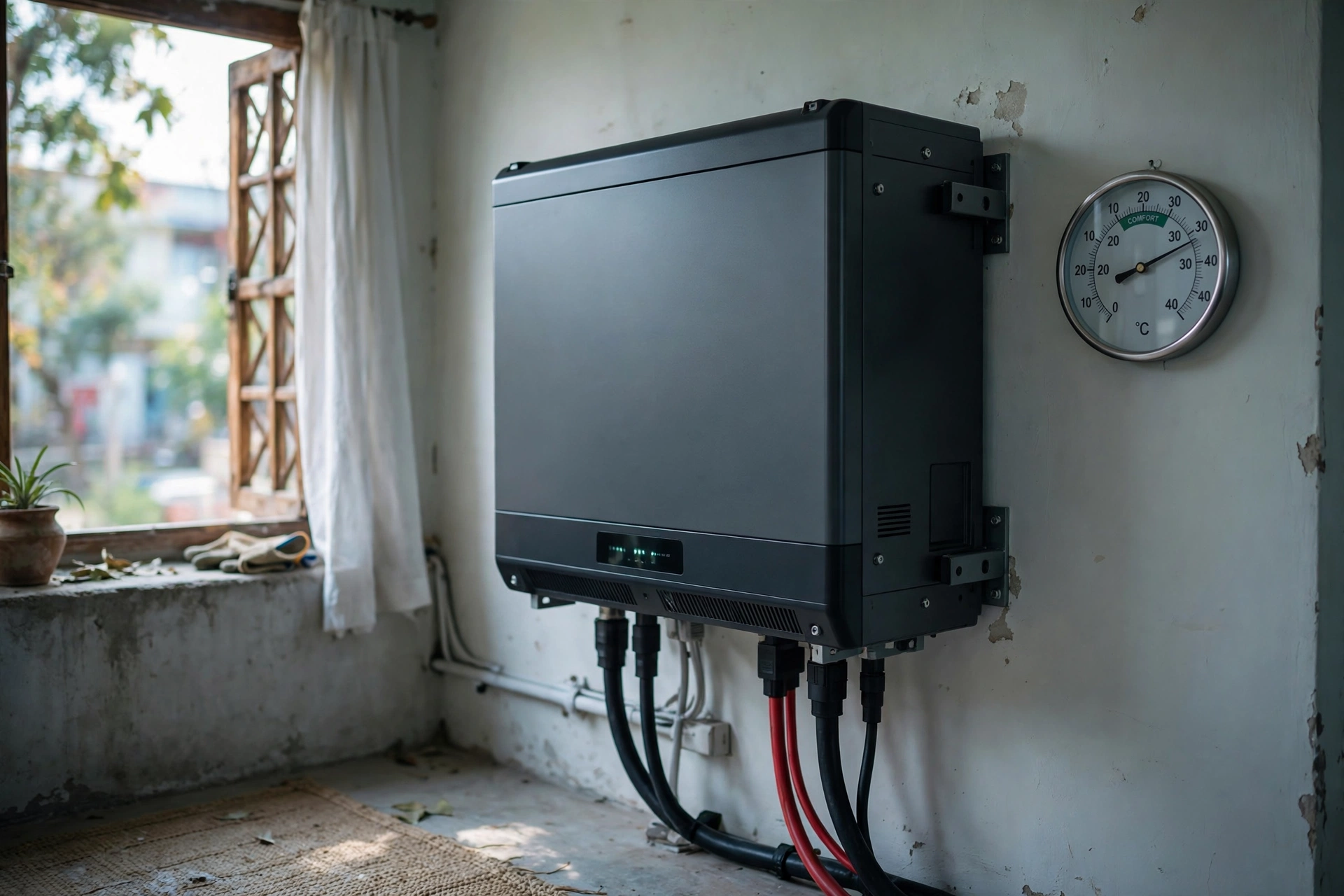
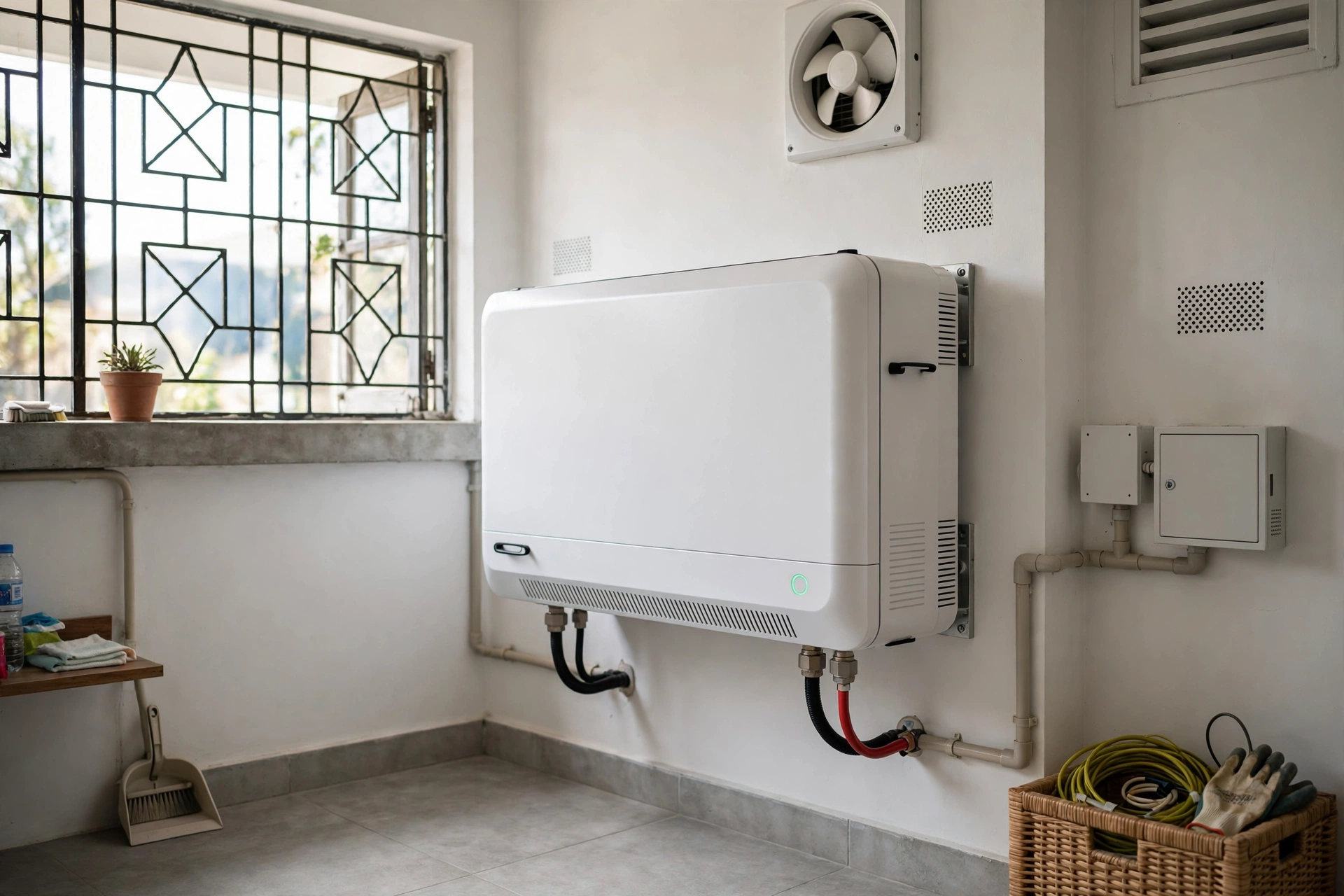
Hot-climate derating. Lahore, Multan and Karachi summers push battery rooms past 40°C. Lithium handles heat better than lead-acid, but sustained high temperatures still accelerate aging and can slightly reduce usable capacity. Install the battery in the coolest ventilated spot available, and if your battery location regularly exceeds 40°C in summer, consider adding ~10% to your sized capacity as a heat margin. Our hot-climate lithium guide covers placement and temperature management in detail.
The self-consumption shift. With net-metering economics in Pakistan changing over recent years, many homeowners now find more value in using their own solar power (daytime generation stored for night use) rather than exporting it. That shifts the sizing logic: a self-consumption bank should be sized for overnight loads (Step 2’s full formula), which is typically larger than a pure load-shedding backup bank. Decide which economics drive your purchase before you size.
Grid charging as a strategy. Hybrid inverters can charge the battery from the grid during off-peak hours. If your area has long outages, topping up from the grid before the evening block is a legitimate strategy — it means you can size slightly smaller than a pure solar-charged system. Just confirm your inverter supports scheduled grid charging.
Frequently Asked Questions
1. How do I calculate what size lithium battery I need for my solar system?
Add up the watts × hours of everything the battery must run to get your daily kWh, then divide by 0.80 (depth of discharge) and by ~0.85 (battery plus inverter efficiency). The shortcut: multiply your daily energy by about 1.5. That gives you the nameplate battery capacity to shop for.
2. How many lithium batteries do I need for a 5 kW solar system in Pakistan?
For backup of a typical 5 kW home (lights, fans, fridge, TV, pump — no AC), two 51.2V 100Ah modules (10.24 kWh total) are a comfortable fit. Add one AC for several hours and plan for three modules (about 15 kWh). Always run your own load audit first — the AC is what decides.
3. Is a single 100Ah lithium battery enough for a home?
A single 51.2V 100Ah battery (5.12 kWh, ~4.1 kWh usable) covers essential loads — lights, fans, TV, internet, fridge — for a typical 4–6 hour outage in a small to mid-size home. It’s not enough for running an AC through the night. A single 12V 100Ah battery (1.28 kWh) is a UPS-class backup, good for one room.
4. Should I buy 12V, 24V or 51.2V lithium batteries?
Match your inverter: 12V for small UPS-style systems, 24V for small backup setups, and 51.2V for 3 kW and larger solar systems. For a whole-home solar system, 51.2V is the standard choice — lower current, thinner cables, better efficiency, and the widest range of available modules.
5. Can I add more batteries later if I start small?
Usually yes — most modern wall-mount lithium batteries support connecting additional identical modules in parallel later. Buy the same brand and model for expansion, since mixing different batteries in one bank causes balancing problems. If you know you’ll expand, confirm parallel support in the datasheet before buying the first module.
6. How long will a 5 kWh lithium battery run my home during load shedding?
Divide the usable energy (~4 kWh at 80% DoD, minus inverter losses) by your hourly load. At 500 W of essential loads (fans, lights, TV, fridge cycling), roughly 6–7 hours. At 1,500 W with an AC running, roughly 2–2.5 hours. The answer is always “it depends on what you run,” which is why the load audit matters.
7. What size battery do I need to run an air conditioner?
A 1.5-ton inverter AC draws roughly 1,200 W while running. For 4 hours of AC backup you need about 4.8 kWh of energy from the battery, which translates to roughly 7 kWh of nameplate capacity after DoD and efficiency — so at least one 51.2V 100Ah module dedicated to the AC, realistically two modules for the AC plus the rest of the home. Also verify the battery’s max discharge current covers the compressor’s startup surge.
8. Is a bigger battery always better?
No. Beyond your realistic worst day plus ~20% margin, extra capacity sits unused while the calendar ages the cells — and batteries are the most expensive component in the system. Size for your actual loads, leave modest expansion headroom, and spend any leftover budget on more solar panels or a better inverter instead.
Conclusion
Choosing the right lithium battery size comes down to four steps: audit your loads in watts × hours, convert daily kWh to battery capacity using 80% depth of discharge and ~85% system efficiency (multiply by roughly 1.5), match the battery voltage to your inverter, and sanity-check against the capacity band for your system size. Most Pakistani homes land on one of three answers — a 12V bank for UPS-style backup, one 5.12 kWh module for a 3 kW home’s essentials, or two to three 5.12 kWh modules for a 5 kW home with AC backup.
The two decisions that matter most are the honest ones: whether the battery must run the AC, and whether you’re buying for load-shedding backup or full night-time self-consumption. Get those right, do the thirty seconds of datasheet math, and you’ll end up with a battery that covers your worst evening without a rupee wasted on capacity you’ll never use.
Sources & Further Reading
- Anern — Sizing a 12V LiFePO4 Battery Bank: The Engineer’s Guide — step-by-step sizing formula including inverter efficiency, autonomy days and 80% DoD.
- Weize — How Do I Size a LiFePO4 Lithium Battery Bank for My System? — DoD selection, voltage matching to system components, and BMS considerations.
- Anern — Lead-acid vs LiFePO4: Off-grid Battery Sizing Guide — usable-capacity comparison, charging efficiency figures (LiFePO4 95–98%), and a full worked sizing formula.
- Roshanex — BYD LV5.0+ 5.12kWh Lithium Battery Price in Pakistan — Pakistan retail price (Rs 265,000, updated October 15, 2026), datasheet specs including ≥95% round-trip efficiency and 6,000+ cycles at 80% DoD.