Lithium Battery Price in Pakistan 2026: What to Expect
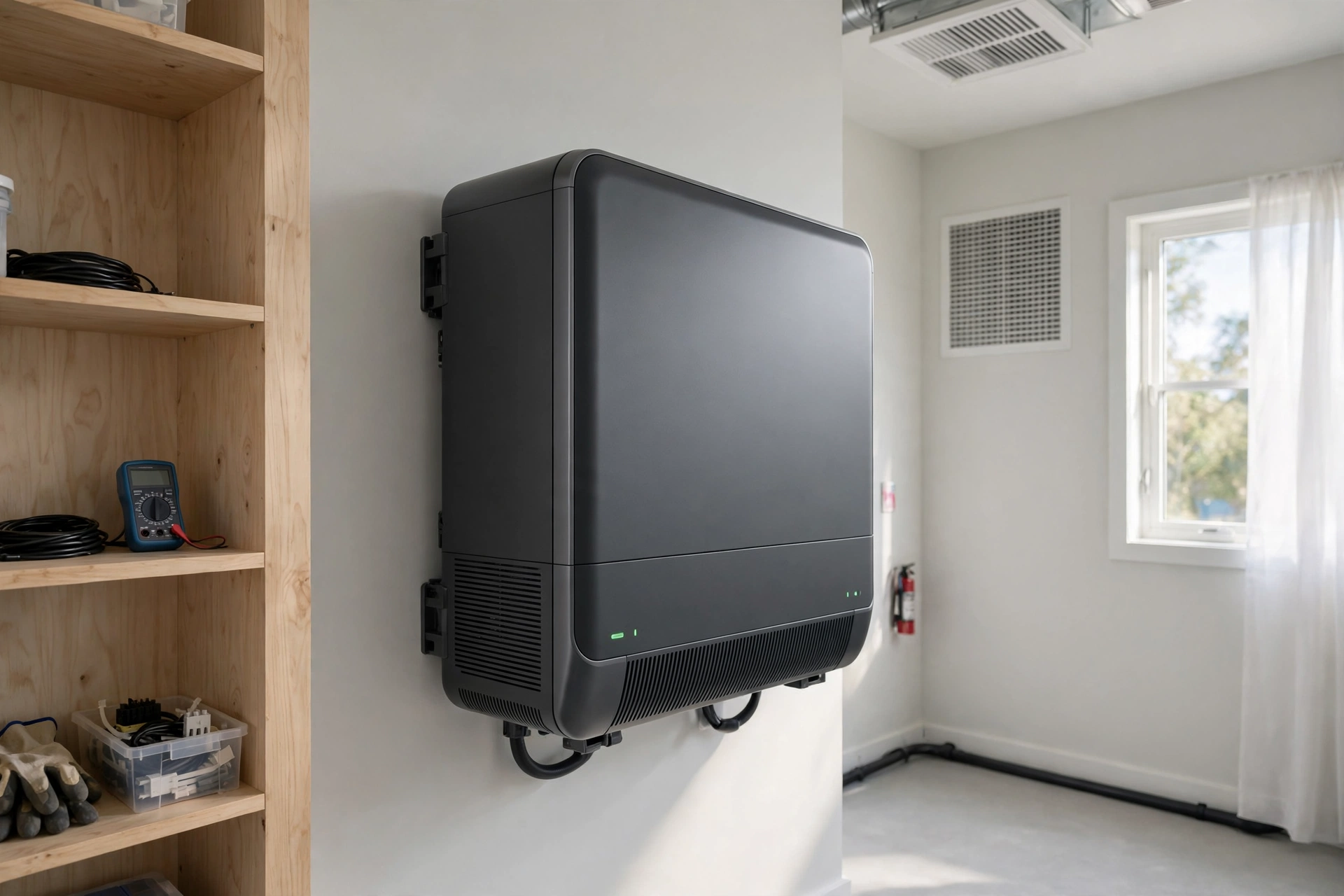
If you are shopping for lithium batteries in Pakistan right now, the market feels both exciting and confusing. Prices have fallen sharply over the last year, more brands are entering the market than ever, and the gap between a PKR 200,000 and a PKR 295,000 “5 kWh” battery is not always obvious. This guide cuts through the noise: what lithium batteries actually cost across Pakistan in 2026, why prices vary so much, how to compare offers on a price-per-kWh basis, and how to avoid the cheap listings that will cost you far more in the long run.
All prices in this guide are rough market ranges as of October 2026, drawn from Pakistani dealer listings, solar retailer price guides, and brand catalogs checked during research. They are not quotes — lithium battery prices in Pakistan move with the dollar rate, import duties, and dealer stock cycles, so always confirm the live price before ordering.
Quick Answer: Lithium Battery Prices at a Glance
- 12V 100Ah LiFePO4 drop-in (1.28 kWh): roughly PKR 55,000–110,000
- 24V 100Ah LiFePO4 (2.56 kWh): roughly PKR 145,000–195,000
- 48V/51.2V 100Ah “5 kWh” wall-mount: roughly PKR 200,000–300,000
- 10 kWh wall-mount/stack (51.2V 200Ah class): roughly PKR 445,000–545,000
- Price per kWh across the market: roughly PKR 28,000–55,000, depending on brand tier
- Budget tier saves 20–30% vs premium tier — but the premium usually buys you a longer warranty, better BMS, and country-wide service
Table of Contents
- Quick Answer: Lithium Battery Prices at a Glance
- Why Lithium Battery Prices Dropped in 2026
- Full Price Table: What Lithium Batteries Cost in Pakistan
- Brand Tiers: Budget vs Mid-Range vs Premium
- 8 Things That Actually Drive the Price
- Price-Per-kWh: The Only Comparison Math That Matters
- Lithium vs Lead-Acid: The Real 10-Year Cost Comparison
- Where to Buy Safely in Pakistan
- Red Flags: How to Spot a Too-Cheap Listing
- Timing: When Prices Dip During the Year
- Buyer’s Checklist Before You Pay
- Frequently Asked Questions
- Conclusion
- Sources & Further Reading
Why Lithium Battery Prices Dropped in 2026
A Pakistani solar retailer price guide updated in October 2026 puts it bluntly: lithium battery prices in the local market dropped roughly 35% over the preceding 18 months. That is not a slow drift — it is the single biggest price move in the history of home energy storage in Pakistan, and it changed the math for every buyer.
Several forces combined to push prices down:
Cell costs collapsed globally. Lithium carbonate and LiFePO4 cell prices fell hard through 2024 and 2025 as Chinese manufacturers expanded capacity faster than demand grew. Pakistan imports virtually all of its lithium battery cells, so every dollar saved at the factory level eventually shows up on Hall Road in Lahore or the dealer market in Karachi.
Local competition exploded. Names that did not exist on the Pakistani market three years ago — DJDC, Apex, Knox, itel Energy — now fight for the same shelf space as established players like Inverex. When five importers all sell a 5 kWh wall-mount battery, the price war is inevitable, and the buyer wins.
The rupee stabilized (relatively). After the violent currency swings of 2022–2023, a steadier rupee meant importers could stop baking large exchange-rate cushions into their prices. Even a modest strengthening of the rupee against the dollar shows up within weeks in battery prices, because importers restock on short cycles.
Scale went up, margins went down. Pakistan imported an estimated 1.25 GWh of lithium battery packs in 2024 alone, and import volumes kept climbing through 2025. Volume importers run on thinner margins than the early niche dealers did — and pass some of that saving on.
The practical takeaway: a 5 kWh lithium battery that listed around PKR 300,000+ in 2024 now sits in a market range closer to PKR 200,000–300,000 as of October 2026. That single shift is what flipped the total-cost-of-ownership calculation decisively against lead-acid — more on that below.
Full Price Table: What Lithium Batteries Cost in Pakistan
The table below gives rough market ranges as of October 2026, compiled from Pakistani dealer listings and price guides. Prices vary by city (Lahore and Karachi are usually cheapest thanks to importer density), by brand tier, and by whether the seller is an authorized dealer or a grey-market importer.
| Battery size | Nominal energy | Typical market range (PKR, Oct 2026) | Best for |
|---|---|---|---|
| 12V 100Ah LiFePO4 drop-in | 1.28 kWh | 55,000–110,000 | Small UPS, lighting backup, caravans |
| 12V 200Ah LiFePO4 | 2.56 kWh | ~170,000 (single listings) | Larger UPS replacement |
| 24V 100Ah LiFePO4 | 2.56 kWh | 145,000–195,000 | 1–3 kW residential setups |
| 51.2V 51Ah (2.6 kWh class) | ~2.6 kWh | ~145,000–165,000 | Entry-level solar storage |
| 48V/51.2V 100Ah “5 kWh” wall-mount | 5.0–5.12 kWh | 200,000–300,000 | Standard 5–8 kW home solar |
| 51.2V 200Ah “10 kWh” wall-mount | ~10.0–10.6 kWh | 445,000–545,000 | Whole-home backup, larger installs |
| 15.36 kWh stacked (51.2V 300Ah) | 15.36 kWh | ~695,000 | Large homes, small commercial |
A few notes on reading this table:
- “5 kWh” is a label, not an exact number. Some brands call a 51.2V 100Ah unit (5.12 kWh) “5 kWh,” others market a true 48V 100Ah unit (4.8 kWh) the same way. When comparing offers, always divide the quoted price by the actual nominal kWh — the price-per-kWh math below shows you how.
- 51.2V is the new “48V.” A 16-cell LiFePO4 stack sits at 51.2V nominal, which matches what most hybrid inverters expect from a “48V” battery. This configuration is now the default recommendation for Pakistani residential installs.
- City gaps are real but small. Lahore and Karachi dealer markets are usually 5–10% cheaper than smaller cities, mainly because importer warehouses sit there. For a PKR 250,000 battery, that is a meaningful difference — but freight to your city often eats half of it.
Brand Tiers: Budget vs Mid-Range vs Premium
This is the pricing companion piece — it explains why tiers cost different amounts, not which brand to buy (our brand-by-brand reviews cover that ground). Think of the Pakistani lithium market in three loose tiers:
Budget tier (roughly PKR 200,000–235,000 for a 5 kWh unit). Volume importers like DJDC and generic-brand units sit here. You typically get universal inverters compatibility, standard BMS protection, and a 3-year service warranty. Best PKR-per-kWh on paper. The tradeoff: limited local service networks (often Karachi-only or Lahore-only) and fewer ecosystem features.
Mid-range tier (roughly PKR 265,000–275,000 for a 5 kWh unit). Brands like Apex and GoodWe sit in this band. You typically get CAN/RS485 inverter communication, longer stated cycle life (up to 6,000+ cycles in spec sheets), and broader dealer networks. Vertex Solar, for example, listed the GoodWe 5 kWh Lynx A at roughly PKR 265,000–270,000 in mid-2026 with a stated 6,000+ cycles at 90% depth of discharge.
Premium tier (roughly PKR 295,000+ for a 5 kWh unit, ~PKR 525,000–545,000 for 10 kWh). Inverex and Knox lead here. The premium buys brand-backed service networks across the country, deeper inverter integration (Inverex batteries pair natively with Inverex hybrid inverters), longer warranty terms (up to 5 years), and stated cycle ratings like 6,000 cycles. Whether that is worth a 20–30% premium depends on how much you value a warranty you can actually claim in your city.
A useful rule of thumb: if two batteries are both genuine LiFePO4 with similar cell origin, the budget option is usually the rational buy for a straightforward installation — and the premium option earns its price only if the service network or inverter integration genuinely matters for your setup.
8 Things That Actually Drive the Price
When two “5 kWh” lithium batteries differ by PKR 80,000, it is usually one or more of these factors — not dealer greed:
1. Chemistry: LiFePO4 vs NMC. Virtually every solar battery sold in Pakistan now is LiFePO4, which is correct for this climate — it handles Pakistan’s summer heat far better than NMC, with manufacturer-stated cycle life of 3,000–6,000 cycles vs 1,000–2,000 for NMC. If you see an unusually cheap “lithium” battery, confirm the chemistry in writing; NMC packs should not be cheaper than LiFePO4, and a mislabeled listing is a red flag on its own.
2. Cell origin and grade. Genuine Grade-A prismatic cells from major Chinese manufacturers cost the importer significantly more than Grade-B or recycled cells. Nothing in the market’s honest tier sells Grade-B openly — the dishonest sellers simply don’t mention cell grade at all. A listing that advertises “Grade A cells” in writing is at least staking a claim you can hold them to.
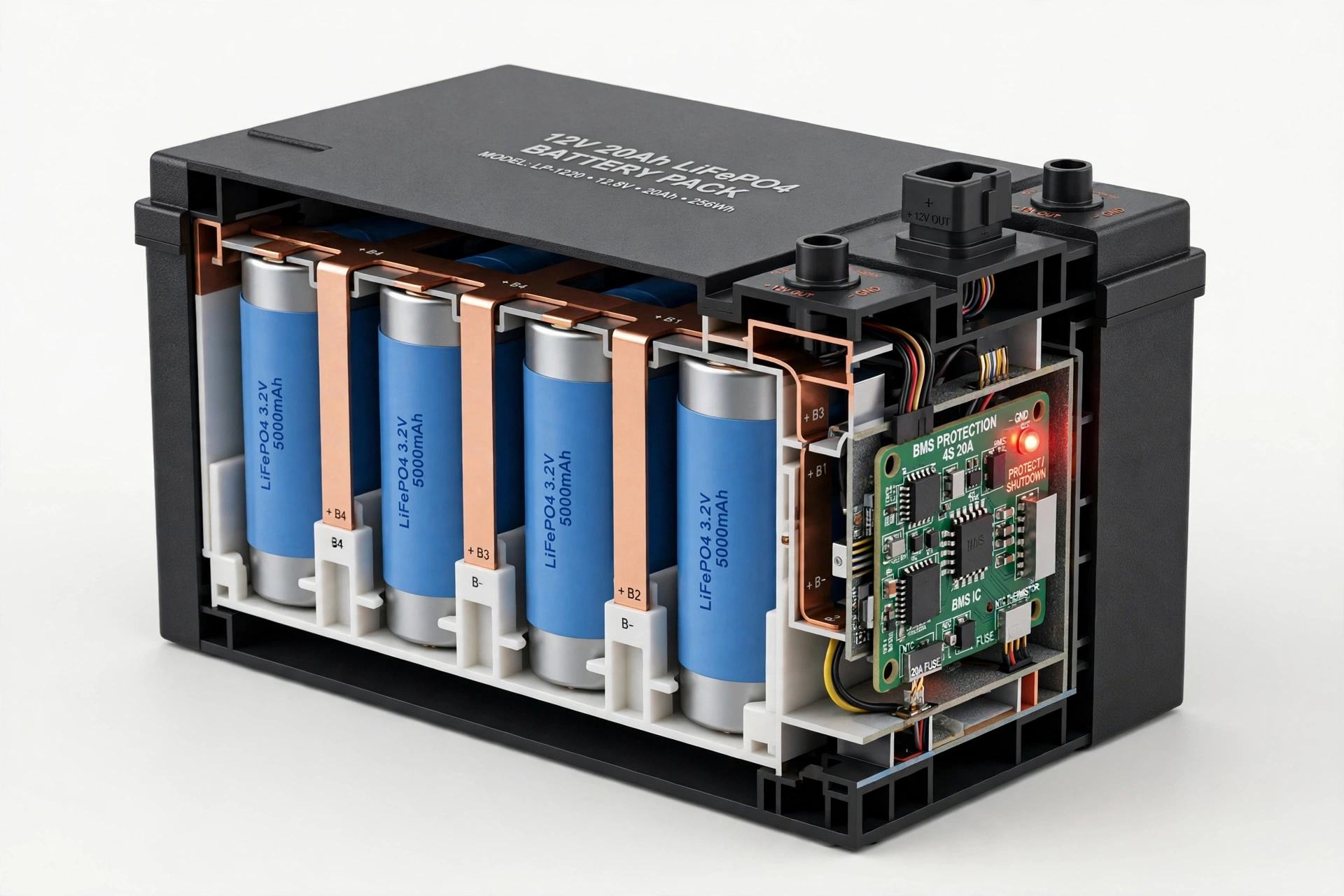
3. BMS quality. The battery management system is the brain of the battery — it handles cell balancing, over-charge and over-discharge protection, temperature cutoffs, and communication with your inverter. A quality BMS with CAN/RS485 communication costs more than a basic protection board. Ask the seller specifically what communication protocols the battery supports.
4. Cycle-life rating. A battery rated for 6,000 cycles at 80% depth of discharge is built with more and better cells than one rated for 3,000 cycles. Manufacturer cycle ratings are lab figures at 25°C — for what they mean in a real Pakistani summer, see our guide on how long lithium batteries last and our cycle-life explainer.
5. Warranty length and type. A 5-year manufacturer warranty priced into a battery costs the brand more than a 3-year service warranty — and a warranty is only as good as the dealer who honors it. This is the one line item buyers underweight most often.
6. Dollar-rate movement. Nearly every cell, BMS board, and enclosure is imported. When the rupee slides, restocking costs rise and retail prices follow within weeks. Conversely, currency stability has been one of the quiet drivers of the 2026 price drop.
7. Official importer vs grey import. Official importers pay full customs duty (lithium batteries carry import duties plus surcharges in Pakistan) and run service centers; grey-market units slip through unofficial channels and undercut by 10–20%. The catch: grey units have no warranty recourse in Pakistan. If the seller cannot show you an official distributor relationship or a stamped warranty card, treat the warranty as nonexistent.
8. Form factor and ecosystem. Wall-mount units with integrated displays and app monitoring cost more to manufacture than bare rack modules. Batteries designed to pair with a specific inverter brand’s communication protocol also carry an integration premium. Decide whether you actually need those features before paying for them.
Price-Per-kWh: The Only Comparison Math That Matters
Comparing battery prices by the sticker alone is meaningless — a PKR 220,000 battery can be a worse deal than a PKR 265,000 one if the cheaper unit stores less energy. The universal comparison is price per kilowatt-hour:
Price ÷ nominal kWh = PKR per kWh
Nominal kWh is easy to compute yourself: Voltage × Amp-hours ÷ 1,000. So a 51.2V 100Ah battery is 51.2 × 100 ÷ 1,000 = 5.12 kWh. Our friends at Hajvery Solar demonstrate the same math on their itel IPB-12100 listing: 12.8 × 100 ÷ 1,000 = 1.28 kWh.
Here is what the per-kWh math looks like across the market ranges observed in October 2026:
| Battery | Nominal kWh | Market range (PKR) | Price per kWh (PKR) |
|---|---|---|---|
| itel 12.8V 100Ah | 1.28 | 55,000 | ~43,000 |
| DJDC 12V 100Ah (dealer listing) | 1.28 | ~70,000 | ~54,700 |
| Generic 12V 100Ah | 1.28 | 85,000–110,000 | ~66,400–85,900 |
| Itel 25.6V 100Ah | 2.56 | ~145,000 | ~56,600 |
| DJDC 5 kWh (51.2V 100Ah) | 5.12 | ~235,000 | ~45,900 |
| Apex 5.12 kWh | 5.12 | ~275,000 | ~53,700 |
| GoodWe 5 kWh | 5.0 | ~265,000–270,000 | ~53,000–54,000 |
| Inverex INV-LV5 5.1 kWh | 5.1 | ~295,000 | ~57,800 |
| DJDC 10 kWh | 10.0 | ~445,000 | ~44,500 |
| Knox 10.2 kWh | 10.2 | ~525,000 | ~51,500 |
| Inverex INV-LV10.6 | 10.6 | ~545,000 | ~51,400 |
| Apex 15.36 kWh | 15.36 | ~695,000 | ~45,200 |
Three patterns jump out:
- Bigger is cheaper per kWh. The 10–15 kWh units consistently land in the low-to-mid PKR 40,000s per kWh, while small drop-ins push toward PKR 55,000–85,000. If your load analysis shows you need 10 kWh, buying one 10 kWh unit beats buying two 5 kWh units on unit economics.
- The brand premium is measurable, not mystical. The per-kWh spread between the cheapest volume importers and the premium tier runs roughly 25–35% — and it buys longer warranties, broader service, and inverter integration.
- Small batteries are expensive per unit of energy. A 12V 100Ah drop-in at ~PKR 55,000–110,000 per 1.28 kWh is two to three times the per-kWh price of a 10 kWh unit. Buy small only when the form factor (UPS replacement, caravan) demands it.
Lithium vs Lead-Acid: The Real 10-Year Cost Comparison
This is where lithium won the argument in 2026. A well-documented market analysis from April 2026 laid out the tubular lead-acid math: a set of four quality tall tubular batteries (210 Ah each) costs roughly PKR 220,000–280,000, but delivers only ~50% usable depth of discharge, needs water top-ups every couple of months, and must be replaced every 3–5 years in Pakistani summer conditions. Normalized over a decade — counting the second replacement, maintenance, and labor — the real cost exceeds PKR 600,000.
Stack that against a 5 kWh LiFePO4 battery:
| Tubular lead-acid (4 × 210Ah) | 5 kWh LiFePO4 lithium | |
|---|---|---|
| Upfront cost (PKR, rough ranges Oct 2026) | 220,000–280,000 | 200,000–300,000 |
| Usable energy | ~50% of nameplate | 90–95% of nameplate |
| Round-trip efficiency | ~75–80% | ~95–98% |
| Stated cycle life | ~1,200–1,500 cycles | 3,000–6,000 cycles |
| Replacement in 10 years | 1–2 full replacements | None (typical) |
| Maintenance | Watering, ventilation, cleaning | Near zero |
| 10-year total cost (rough estimate) | 600,000+ | 200,000–350,000 incl. install |
The efficiency gap deserves emphasis because it is invisible on day one: a 95–98% efficient lithium battery extracts roughly 15–20% more usable energy from the same solar array every single day compared to a 75–80% efficient lead-acid bank. That is free electricity, compounded over years.
For the full chemistry comparison, see our detailed lithium vs lead-acid battery guide. The bottom line for 2026: lithium now costs roughly the same as lead-acid upfront and roughly half as much over a decade. The only scenario where tubular batteries still win is a cash-strapped buyer who cannot stretch the upfront budget at all — and even then, a small lithium drop-in is often the smarter stretch.
Where to Buy Safely in Pakistan
Price is only half the decision. A lithium battery is a 10-year appliance, and the seller you choose determines whether the warranty on the box means anything in year four.
Buy from authorized dealers and distributors. Legitimate dealers — Hajvery Solar as an authorized itel distributor, Vertex Solar as an official partner for GoodWe, and the country-wide dealer networks of Inverex and Knox — can show you a stamped warranty card and a traceable serial number. One dealer put it well on their product page: they guarantee original products with traceable serials and refuse refurbished or B-grade cells. That is the standard every seller should meet.
Demand the warranty in writing, on a stamped card. Not a WhatsApp promise — a printed, stamped warranty card with the battery’s serial number, the warranty term, and the dealer’s stamp. Ask specifically: service warranty or replacement warranty? What does the claim process look like? Who pays freight to the service center? The answers separate real warranties from marketing.
Check inverter compatibility before you pay. Most modern hybrid inverters from the major brands support lithium via CAN/RS485 communication, but older or budget inverters may not — and running lithium on a lead-acid charge profile shortens its life. Confirm your inverter’s battery settings support LiFePO4 and the specific voltage of the battery you are buying.
Inspect what arrives. Check the box seal, the serial number on the unit against the warranty card, and the physical condition. Genuine LiFePO4 units from major brands increasingly carry QR codes or verifiable serials. Heat damage, dented enclosures, or mismatched packaging on arrival are reasons to refuse delivery, not negotiate a discount.
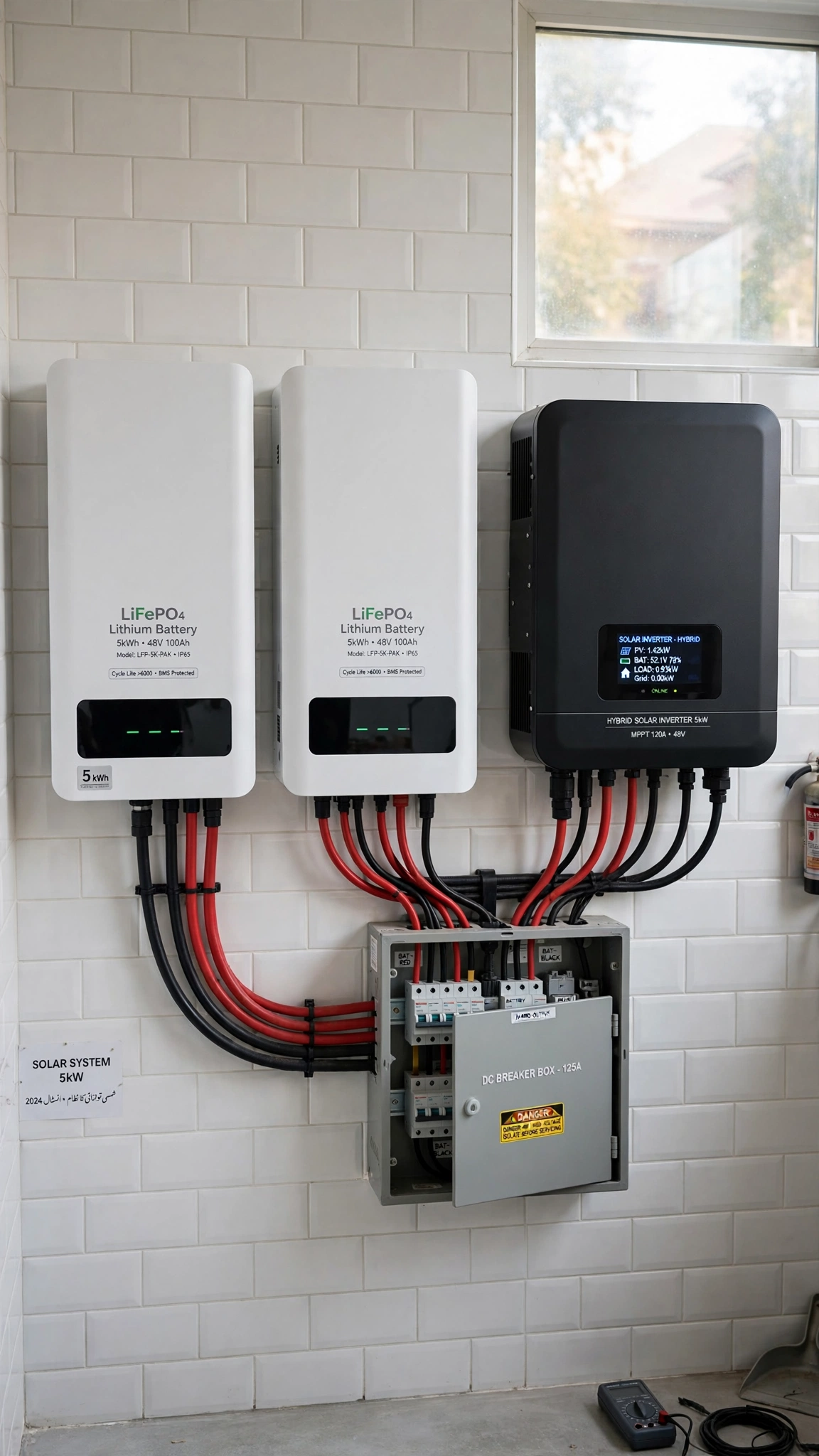
Get a proper installation. Battery-to-inverter DC cabling, breakers, and surge protection are not optional extras — reputable battery warranties assume correct installation. Budget roughly PKR 14,000–18,000 for DC protection components plus cabling and labor on top of the battery price. A battery that fails because of bad wiring voids your warranty regardless of the brand.
For brand-level comparisons before you shop, our best lithium battery for solar system guide breaks down which names suit which setups.
Red Flags: How to Spot a Too-Cheap Listing
The Pakistani market has a genuine problem with suspiciously cheap lithium listings — OLX and Facebook Marketplace carry 12V 100Ah offers as low as PKR 40,000–50,000, well under the legitimate market floor. An April 2026 field analysis flagged the pattern precisely: a 5 kWh battery listed near PKR 180,000 when the market floor sat around PKR 240,000 was “almost certainly using recycled cells.”
Watch for these red flags:
- Price far below the market floor. If the going range for a 5 kWh unit is roughly PKR 200,000–275,000 and someone offers you one at PKR 150,000, the cells inside are not what the label says. Recycled or Grade-B cells, rewrapped with a fresh sticker, are the classic trick.
- No brand, no model number, no datasheet. Legitimate batteries have model numbers, spec sheets, and certifications (look for IEC62619, UN38.3 — the same standards listed on genuine itel units). A listing that only says “lithium battery 5kW” is selling you a mystery box.
- Cycle-life claims without conditions. “8,000+ cycles” on a budget battery with no stated test conditions (temperature, DoD, charge rate) is marketing, not engineering. Genuine ratings look like “3,000+ cycles at 25°C, 80% DoD” — with the conditions attached.
- Advance payment demanded, no physical shop. Never pay in full before inspecting the battery. Scam sellers on classified sites routinely vanish after advance transfers.
- Warranty claims that don’t add up. “5-year replacement warranty” from a seller with no service center and no distributor relationship is fiction. Replacement warranties are rare and expensive to honor; most legitimate warranties in Pakistan are service warranties.
- Used or “refurbished” units priced like new. A second-hand lithium battery of unknown history can look fine and die in a year. If you are considering a used unit at all, at least run the checks in our guide on how to check lithium battery health first — and expect a steep discount for the risk.
Timing: When Prices Dip During the Year
Lithium battery prices in Pakistan are not seasonal in the way solar panel prices are, but there are rhythms worth knowing:
Post-monsoon and pre-winter (October–December) often bring the year’s best deals. Importers who stocked heavily for the summer solar rush start clearing inventory, and you are reading this in exactly that window. Promotional pricing in this quarter is common.
New model launches create clearance windows. When a brand refreshes a battery line, outgoing models get discounted 10–15%. A clearance-price battery from a legitimate brand is one of the best value buys in the market — same cells, same warranty, lower price.
Dollar-rate dips are buying opportunities. Because nearly the entire cost base is imported, a strengthening rupee shows up in retail prices within weeks. If the rupee firms for a month, dealer quotes soften. There is no need to time the currency market precisely — but if you see headlines about rupee strength, that is a good week to get quotes.
Avoid buying at peak summer desperation. May–July is when load-shedding panic peaks and dealers know it. Prices are stickiest then, and stock of popular models runs thin. If you can plan your purchase for the shoulder seasons, you will usually pay less and have more choice.
One caution on timing: batteries degrade in storage, especially in hot warehouses. A battery that has sat in a non-climate-controlled warehouse through a Karachi summer is not the same product as a fresh import — another reason to buy from high-turnover authorized dealers rather than whoever has the oldest, cheapest stock. For more on storage effects, see our article on whether lithium batteries degrade when not in use.
Buyer’s Checklist Before You Pay
Run through this list before money changes hands:
- Compute price per kWh for every offer (price ÷ nominal kWh). Compare that number, not the sticker.
- Confirm the chemistry in writing — LiFePO4 for Pakistani solar storage, with the model number and datasheet.
- Read the cycle-life fine print — cycles at what temperature, what depth of discharge, to what end-of-life capacity.
- Get the warranty on a stamped card — term, type (service vs replacement), claim process, who pays freight.
- Verify the seller’s authorization — official distributor or dealer relationship, physical shop or warehouse, traceable serial numbers.
- Confirm inverter compatibility — voltage match, LiFePO4 charge profile support, CAN/RS485 if you want smart communication.
- Budget the full install — battery price + DC protection (~PKR 14,000–18,000) + cabling + labor.
- Protect the battery after install — correct charge settings and temperature management decide whether you get the rated life. See what damages lithium batteries for the mistakes that void warranties.
Frequently Asked Questions
What is the price of a 5 kWh lithium battery in Pakistan in 2026?
Rough market range as of October 2026: PKR 200,000–300,000 depending on brand tier. Volume-importer units (DJDC-class) sit near PKR 235,000, mid-range brands (Apex, GoodWe) around PKR 265,000–275,000, and premium brands (Inverex) near PKR 295,000. Always confirm live pricing with the dealer before ordering.
What is the cheapest lithium battery in Pakistan right now?
At the small end, branded 12V 100Ah LiFePO4 units list around PKR 55,000–70,000 (itel IPB-12100 at ~PKR 55,000 through an authorized distributor; DJDC 12V 100Ah around PKR 70,000), while unbranded/generic 12V 100Ah units range roughly PKR 85,000–110,000. Anything far below these floors on classified sites should be treated with suspicion.
Is lithium cheaper than lead-acid in Pakistan in 2026?
Upfront, roughly equal; over a decade, lithium is decisively cheaper. A 5 kWh lithium battery (roughly PKR 200,000–300,000) replaces a tubular bank costing PKR 220,000–280,000 — but the tubular bank needs replacement in 3–5 years and constant maintenance, pushing its 10-year cost past PKR 600,000. Lithium’s 10-year cost typically stays in the PKR 200,000–350,000 band including installation.
Why do two “5 kWh” batteries have such different prices?
Cell grade, BMS quality, stated cycle life, warranty length, official-importer vs grey-import status, and brand service networks. A PKR 235,000 and a PKR 295,000 battery can both be genuine LiFePO4 — the premium buys a longer warranty, country-wide service, and deeper inverter integration. Compare price per kWh first, then weigh what the premium actually includes.
Should I buy a grey-import lithium battery to save money?
It is a gamble, not a saving. Grey imports typically undercut official channels by 10–20% but carry no enforceable warranty in Pakistan. On a PKR 250,000 purchase with a 10-year expected life, giving up the warranty to save PKR 30,000 is poor math — especially since warranty claims are exactly when you need the seller most.
When is the best time to buy a lithium battery in Pakistan?
October–December is typically the sweet spot: post-summer inventory clearance meets promotional pricing. Avoid panic-buying during peak load-shedding months (May–July) when prices are stickiest and popular models go out of stock.
Can I install a lithium battery myself to save money?
Physically mounting a wall unit is simple; the electrical work is not. Battery-to-inverter DC runs carry high continuous current and require proper breakers, fusing, and surge protection — and most battery warranties assume professional installation. A bad DIY install can void your warranty and create a genuine fire risk. Pay the installer.
How do I verify a lithium battery is genuine?
Check for a verifiable serial number or QR code, an official datasheet with stated test conditions for cycle life, certifications like IEC62619/UN38.3, a stamped warranty card from an authorized dealer, and a price within the legitimate market range. Prices far below market are the single most reliable indicator of recycled or Grade-B cells.
Conclusion
The lithium battery market in Pakistan in 2026 is the best it has ever been for buyers: a 5 kWh LiFePO4 battery sits in a rough range of PKR 200,000–300,000, a 10 kWh unit around PKR 445,000–545,000, and the per-kWh economics now beat lead-acid over any horizon longer than a few years. Prices fell roughly 35% in eighteen months, and the only buyers still choosing tubular lead-acid are those who cannot stretch the upfront budget at all.
Three rules will protect your money. First, compare on price per kWh, not the sticker — divide every quote by the battery’s actual nominal energy. Second, buy the warranty, not just the battery — an authorized dealer with a stamped warranty card and a real service network is worth a 10–15% premium over a grey-market bargain. Third, treat too-cheap listings as guilty until proven innocent — recycled cells in a fresh wrapper are the market’s oldest trick, and the market floor exists for a reason.
Get those three right, and a 2026 lithium battery will quietly do its job for a decade: no watering, no fumes, no 2 a.m. inverter trips — just power when the grid isn’t there.
Sources & Further Reading
- CNC Electric — “Lithium Battery Price in Pakistan 2026 — LiFePO4 48V Buyer Guide + DC Protection” (price table from June 2026 market, updated October 15, 2026). cncelectric.pk
- A Grade Solar Karachi — DJDC Dongjin 12V 100Ah LiFePO4 product listing (Rs. 70,000 at time of research; showed out of stock). agradesolar.pk
- Hajvery Solar Energy — itel Energy IPB-12100 12.8V 100Ah LiFePO4 product page (Rs. 55,000, 3-year service warranty, itel authorized distributor). hajverysolar.com
- Vertex Solar Solution — GoodWe 5kWh 51.2V 100Ah LiFePO4 product page (Rs. 265,000–270,000, stated 6,000+ cycles). vertexsolarsolution.com
- Hassan Khan — “Lithium Battery Solar System Pakistan: The Quiet Revolution” (April 2026; tubular lead-acid vs lithium TCO analysis, market import figures). medium.com
- Saibazone internal: How Long Do Lithium Batteries Last · Lithium Battery Cycles Explained · Lithium vs Lead-Acid Battery · Best Lithium Battery for Solar System · What Damages Lithium Batteries · How to Check Lithium Battery Health · Do Lithium Batteries Degrade When Not in Use